

CENTER FOR COMPUTATIONAL ELECTROMAGNETICS
🎓 Get Certified in Antenna Design & Simulation
The Professional Certification Track for:
Learning Antennas Through Simulation: A Hands-On Guide with AN-SOF
Master the curriculum, complete 5 Simulation Labs, and earn your Professional Proficiency Credential.
What is the AN-SOF Certification Track?
It is a structured professional development program built directly into the book “Learning Antennas Through Simulation.”
- The Knowledge: You will have full access to the interactive book for one year.
- The Application: You complete the 5 Simulation Labs integrated into the chapters.
- The Proof: You submit your Lab Reports to earn your Certificate of Technical Proficiency.
Who it’s for:
Designed for students and engineers who need to bridge the gap between classroom theory and real-world simulation accuracy and want the credentials to prove it.
Read a free sample:
📖 Book Section 1.4 The Hertzian Dipole
🔬 Lab 1: Radiation & Ideal Physics
About the Author & Lead Instructor:

Have a question?
💬 Ask me | 📧 Email me | 🌐 Follow me
The Curriculum: 5 Steps to Proficiency
This program is structured into five core professional competencies. Each chapter concludes with a Simulation Lab Challenge that must be completed for certification.
- Radiation & Ideal Physics: Mastering the foundations of EM modeling and ideal antennas.
- Performance & Metrics: Analyzing Gain, Directivity, Efficiency, Front-to-Back Ratio, and Bandwidth.
- Linear Antenna Design: Professional engineering of Dipole and Monopole systems.
- Advanced Architectures: Designing for complexity: Arrays, Helices, and Log-Periodics.
- CEM & Simulation Pro: Achieving numerical precision, convergence, and high-frequency accuracy.
Estimated Completion Timeline
This program is designed to be a flexible but structured professional track. By dedicating approximately two hours per day, you can master one technical module per week. At this pace, you will complete the full curriculum and earn your Certificate of Technical Proficiency in five weeks.
What’s Inside the Book:
- 50+ Simulation Examples: Real-world scenarios from Dipoles to Complex Arrays.
- Interactive Calculators: Built-in tools for radiation resistance, gain, and impedance.
- 5 Professional Labs: The assessment modules required for your certification.
Earn the “Golden Standard” Credential
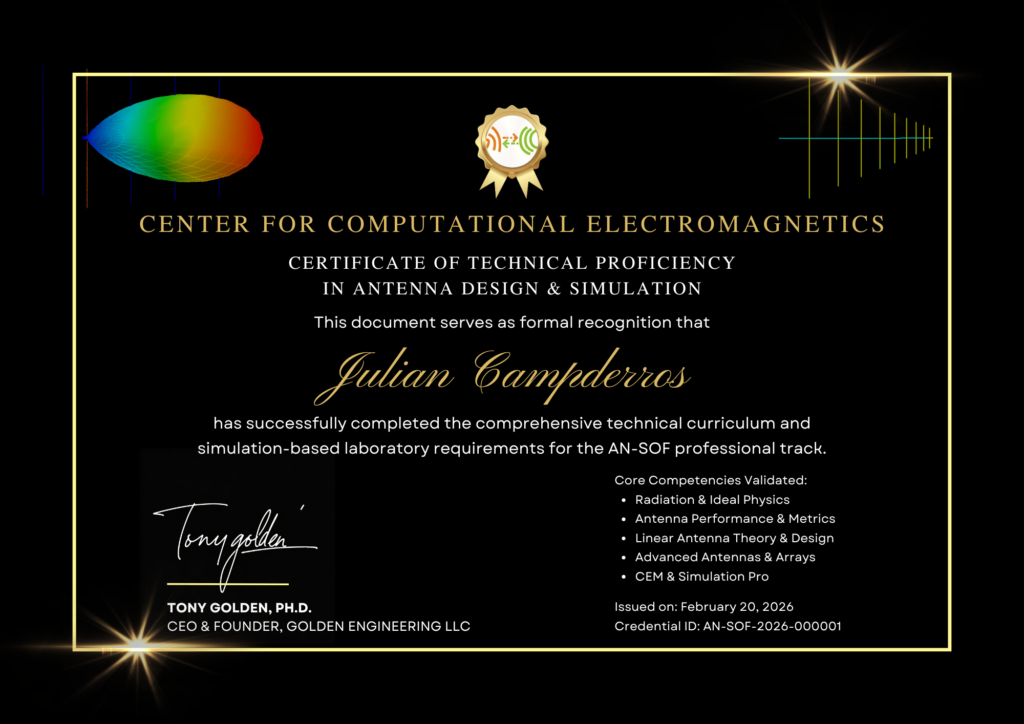
Upon finishing the final chapter of “Learning Antennas Through Simulation” and submitting your Lab Reports, you will receive a verifiable Certificate of Technical Proficiency signed by Tony Golden, Ph.D.
Enroll & Get Access Now
Enrollment Fee: $99 (First Year)
Includes the complete interactive book, 5 Lab Challenges, and your Certification Review.
Note: Access includes all book updates and interactive calculators. Stay current with a discounted $49/year renewal (Optional/Manual).
💬 Have questions? Read the FAQs →
🛡️ No Auto-Renewal: renew manually after 1 year if you wish.
Learning Antennas Through Simulation:
A Hands-On Guide with AN-SOF
By TONY GOLDEN
RF Engineer & Physics Ph.D. | CEO & Founder | Golden Engineering LLC
📖 Table of Contents
1. Ideal Antennas
- 1.1 Maxwell’s Equations and Electromagnetic Radiation
- 1.2 The Isotropic Radiator
- 1.3 Arrays of Point Sources
- 1.4 The Hertzian Dipole – FREE SAMPLE
- 1.5 The Short Dipole
- 1.6 The Half-Wave Dipole
- 1.7 Thin Dipoles of Arbitrary Length
- 1.8 Ground Plane and Image Theory
- 1.9 Monopole Antennas
- Lab 1: Radiation & Ideal Physics
2. Antenna Metrics
- 2.1 Radiation Pattern Fundamentals
- 2.2 Polarization
- 2.3 Radiated Power and Energy Conservation
- 2.4 Radiation Resistance
- 2.5 Radiation Efficiency
- 2.6 Directivity and Gain
- 2.7 Beamwidth and Sidelobes
- 2.8 Feedpoint Impedance and Bandwidth
- 2.9 The Reciprocity Principle
- 2.10 Receiving Mode Operation
- 2.11 Effective Aperture and Gain
- 2.12 The Friis Transmission Equation
- Lab 2: Performance & Metrics
3. Linear Antennas
- 3.1 Cylindrical Wire Antennas
- 3.2 Input Impedance and Feedpoint Modeling
- 3.3 Induced EMF Method
- 3.4 Hallén’s Integral Equation
- 3.5 King–Middleton Formulation
- 3.6 Equivalent Radius for Non-Circular Wires
- 3.7 Self and Mutual Impedances
- Lab 3: Linear Antenna Design
4. Advanced Antennas
- 4.1 Loop Antennas
- 4.2 Helical Antennas
- 4.3 Yagi-Uda Arrays
- 4.4 Log-Periodic Arrays
- 4.5 Horn Antennas
- 4.6 Parabolic Reflectors
- 4.7 Fractal Antennas
- 4.8 Microstrip and Printed Antennas
- Lab 4: Advanced Architectures
5. Simulation Methods
- 5.1 Introduction to Antenna Simulation
- 5.2 Differential Equation Methods
- 5.3 Integral Equation Methods
- 5.4 Hybrid Numerical Techniques
- 5.5 Method of Moments (MoM)
- Lab 5: CEM & Simulation Pro
Stop Guessing. Start Simulating.
🛡️ No Auto-Renewal: renew manually after 1 year if you wish.
Have questions about the Certification or institutional access? Contact Tony Directly.
Join a Global Community of RF Experts
Our technical insights are trusted by engineers and antenna enthusiasts at top-tier firms and research institutions. See how they use AN-SOF →