Search for answers or browse our Knowledge Base.
Guides | Models | Validation | Book
Resonant Radar Cross Section (RCS) Analysis of a Jet Trainer in the HF Band
Discover how airframe resonance turns a 16m jet trainer into a massive 1,000 m² radar target at 9 MHz. This AN-SOF study analyzes RCS behavior across the HF band, detailing the transition from ‘donut’ patterns to forward-scattered lobes and explaining why these resonant signatures are the key to OTH radar and counter-stealth detection.

The Physics of Airframe Resonance
In the study of Radar Cross Section (RCS), the “Resonant Region” (or Mie Scattering region) occurs when the wavelength of the incident electromagnetic wave is comparable to the physical dimensions of the target. For a typical jet trainer aircraft with a 16-meter fuselage and a 16.3-meter wingspan, this resonance falls within the High Frequency (HF) band (3–30 MHz).
Unlike high-frequency radar (X-band or K-band) where scattering is dominated by local “specular” reflections from flat surfaces, HF scattering is a global phenomenon. The entire airframe behaves as a complex resonator. This simulation analyzes the bistatic scattering characteristics of such a platform under plane wave excitation.
Simulation Parameters and Methodology
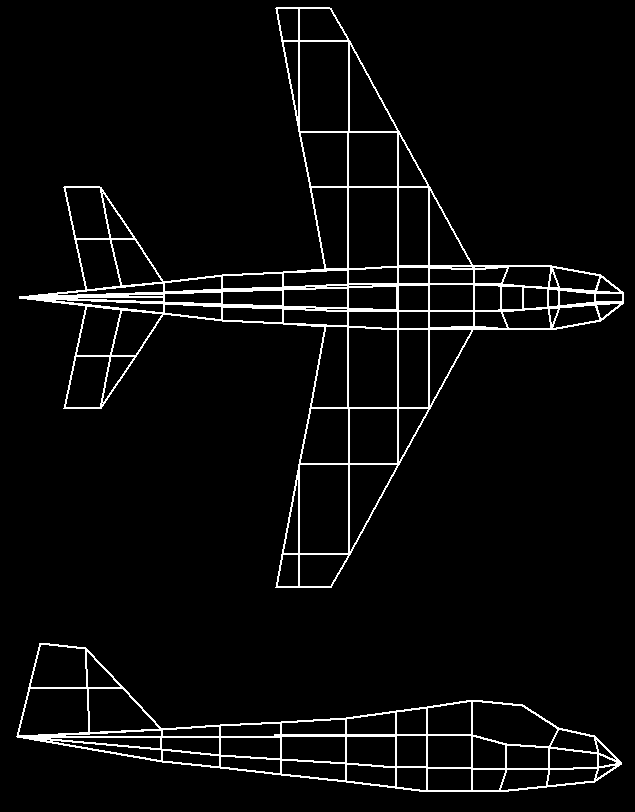
The aircraft was modeled in AN-SOF using a wire-grid discretization (Fig. 1). The simulation environment was configured as follows:
- Target Dimensions: 16m Length, 16.3m Wingspan, 1.8m Fuselage width.
- Excitation Source: A plane wave impinging head-on (along the longitudinal axis from the front).
- Polarization: Linear polarization with the Electric Field ($E_{inc}$) aligned parallel to the wings.
- Frequency Sweep: 5 MHz to 30 MHz.
Quantitative RCS Analysis: m2 vs. dBsw
The simulation reveals three distinct resonant peaks (Fig. 2), corresponding to the harmonic modes of the airframe’s metallic structure.
| Frequency | RCS (Square Meters) | RCS (dBsw) | Structural Correlation |
| ~9 MHz | 1,000 $m^2$ | -1 dBsw | Primary Wingspan Resonance ($\lambda/2 \approx$ Wingspan) |
| ~17 MHz | 500 $m^2$ | 2 dBsw | Full-wave airframe resonance / Fuselage interaction |
| ~25 MHz | 500 $m^2$ | 5.5 dBsw | Higher-order harmonic modes ($3\lambda/2$) |
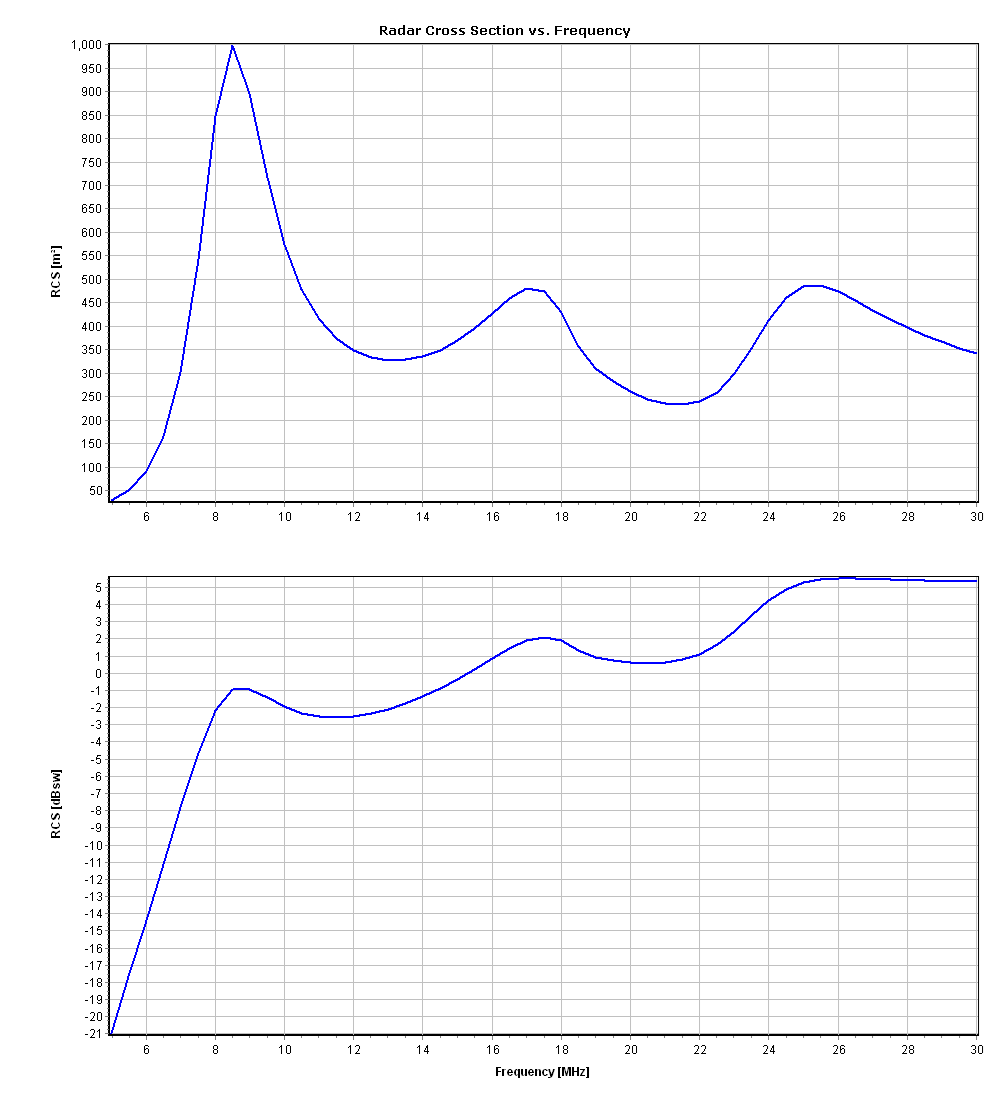
The primary peak at 9 MHz is the most significant from a detection standpoint. At this frequency, the 16.3m wingspan is approximately half a wavelength ($\lambda/2$). The E-field polarization induces a massive resonant current along the wings, effectively turning the aircraft into a resonant dipole. While the absolute area return ($m^2$) is highest at the first resonance, the RCS expressed in dBsw (decibels relative to a square wavelength) increases at higher frequencies, indicating that the aircraft becomes a more “efficient” scatterer relative to the decreasing wavelength.
Evolution of the Scattered Radiation Pattern
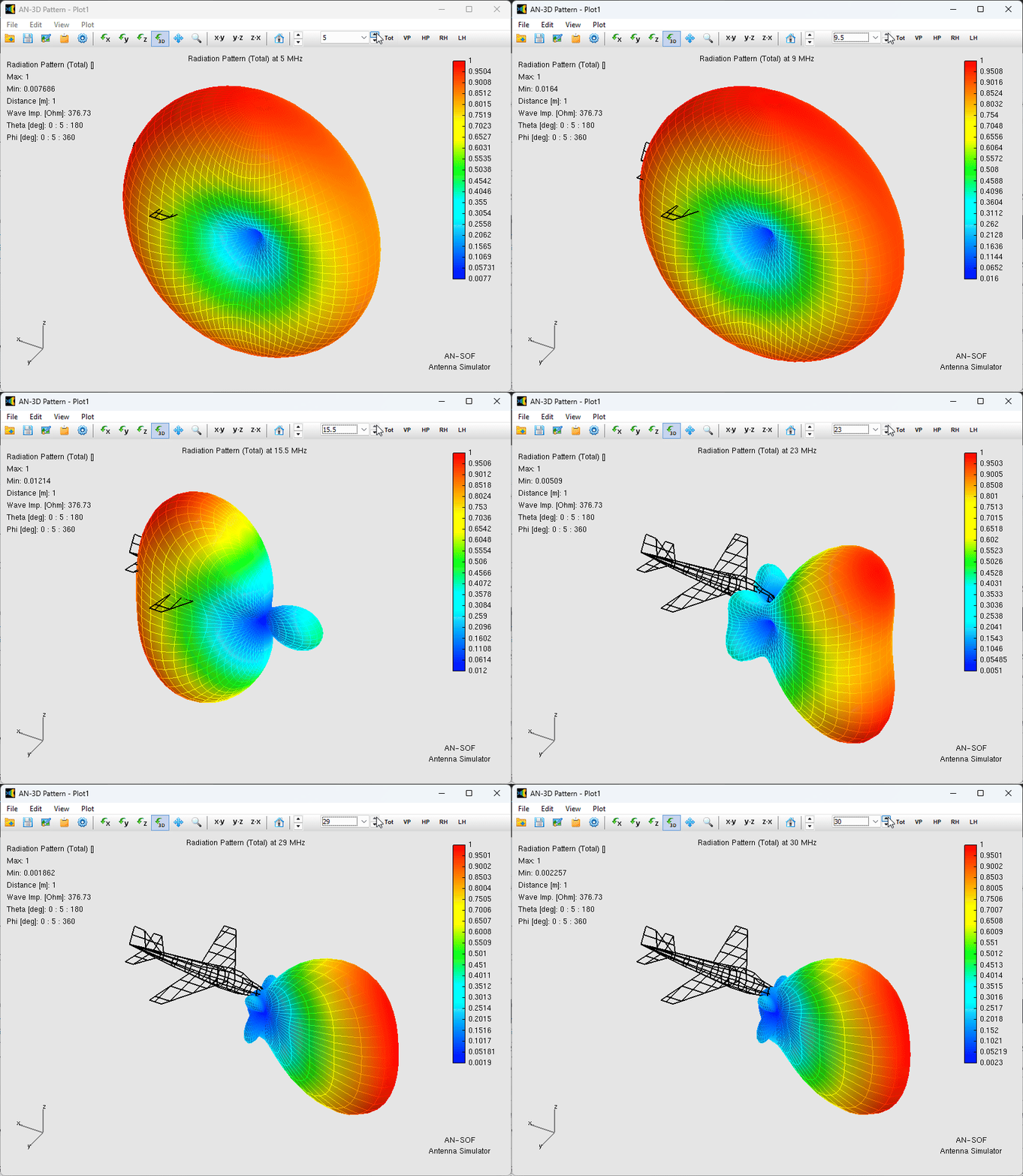
The scattered field (the field re-radiated by the induced currents on the airframe) undergoes a dramatic spatial transformation as the frequency increases (Fig. 3).
- Low Frequency (< 9 MHz): The scattered pattern is essentially “donut-shaped.” The aircraft is electrically small, behaving as a simple short dipole. Radiation is nearly omnidirectional in the plane perpendicular to the wings.
- Resonant Transition (9–17 MHz): As the aircraft enters the resonant region, interference between currents on different parts of the airframe begins to shape the pattern. A directional main lobe forms, pointing predominantly backwards (toward the aircraft tail). This represents a strong wave return to the radar source.
- High Frequency (> 17 MHz): Above the second resonance, the directionality undergoes a complete reversal. The scattered field develops a powerful main lobe pointing forward (toward the aircraft front).
Conclusions and Application in OTH Radar
The simulation results provide a CEM validation of why the HF band is utilized for Over-the-Horizon (OTH) Radar systems.
- Counter-Stealth Capability: At the 9 MHz resonance, the 1,000 $m^2$ RCS return is several orders of magnitude larger than the target’s physical cross-section. Geometric stealth features (faceted surfaces or RAM coatings) designed for centimeter-wave radars are ineffective at these wavelengths, as the airframe resonance is determined by gross physical dimensions rather than surface texture.
- Polarization Sensitivity: The high return at 9 MHz is strictly dependent on the horizontal polarization of the incident wave. If the radar were vertically polarized, the fuselage (only 1.8m wide) would remain electrically “thin,” resulting in a much lower RCS.
- Diagnostic Power of AN-SOF: The shift from a back-firing to a forward-firing scattered pattern demonstrates the software’s ability to model the transition from the Rayleigh region into the early Optical region, providing essential data for bistatic radar placement strategies.
See Also
Technical Keywords: Radar Cross Section (RCS), Resonant Region, Mie Scattering, HF Radar, Plane Wave Excitation, Wire-Grid Aircraft Modeling, Forward Scattering, Airframe Resonance.