Search for answers or browse our Knowledge Base.
Guides | Models | Validation | Book
High-Gain Biquad Antenna with Planar Reflector: Analysis and Applications for the 866.5 MHz ISM Band
Discover the design and performance characteristics of a high-gain Biquad antenna with a planar reflector for the 866.5 MHz ISM band. This AN-SOF analysis details the antenna’s 10.5 dBi gain, 10% impedance bandwidth, and exceptional beam symmetry, providing a professional-grade directional solution for LoRaWAN, UHF RFID, and long-range telemetry applications.
Introduction to the Biquad Radiator
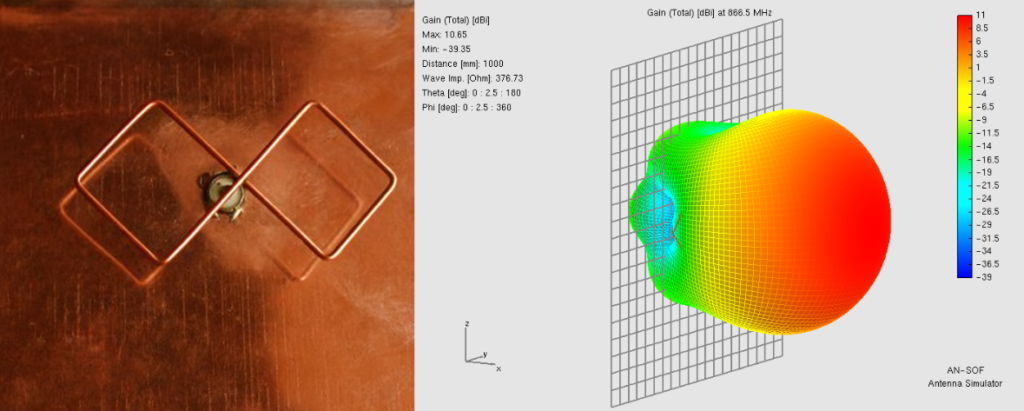
The Biquad antenna, often referred to as a Harchenko antenna, is a high-gain directional radiator consisting of two loop elements configured in a “figure-eight” shape (Fig. 1). Traditionally favored in the microwave and UHF communities for its simplicity and robustness, the Biquad provides a significant performance boost over standard dipoles. When placed in front of a metallic reflector, the antenna transitions from an omnidirectional radiator to a highly directional system, making it an ideal candidate for point-to-point communication, telemetry, and long-range sensing in the $866.5 \text{ MHz}$ Industrial, Scientific, and Medical (ISM) band.

Design Specifications and Geometric Configuration
For operation at a center frequency of $866.5 \text{ MHz}$ ($\lambda \approx 346 \text{ mm}$), the antenna must be precisely dimensioned to ensure resonance and optimal coupling with the reflector. The model presented here is constructed from $3 \text{ mm}$ diameter conductive wire, providing structural rigidity and a stable surface area for current distribution (Fig. 2).
The Radiating Element:
- Quad Side: $S = 89.1 \text{ mm}$ (approximately $0.258\lambda$).
- Quad Diagonal: $D = 126 \text{ mm}$.
- Total Length: $L = 2D = 252 \text{ mm}$. The geometry consists of two interconnected square loops. The choice of 89.1 mm for each side ensures that the total perimeter of each loop is approximately one wavelength, the fundamental condition for the Biquad’s resonant mode.
The Reflector System:
The backplane reflector is a square PEC (Perfect Electric Conductor) surface, measuring $380 \text{ mm} \times 380 \text{ mm}$ ($W = 380 \text{ mm}$ in Fig. 2), which represents approximately $1.1\lambda \times 1.1\lambda$. The reflector is positioned at a distance of $h = 42 \text{ mm}$ ($\approx 0.12\lambda$) from the biquad radiator. This spacing is a critical design variable; at $0.12\lambda$, the reflected wave reinforces the forward radiation through constructive interference while maintaining a manageable input impedance close to the 50-Ohm standard.
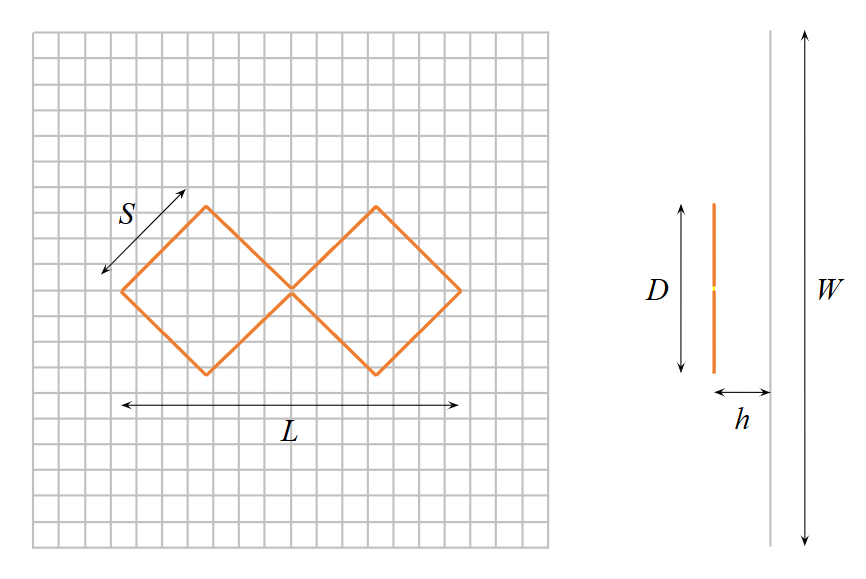
The reflector in AN-SOF is modeled as a solid surface composed of 20 x 20 facets. The antenna is fed by connecting a short vertical wire with a 1V voltage source at the center of the biquad, which is the point where the two square loops meet.
Numerical Analysis and Impedance Characterization
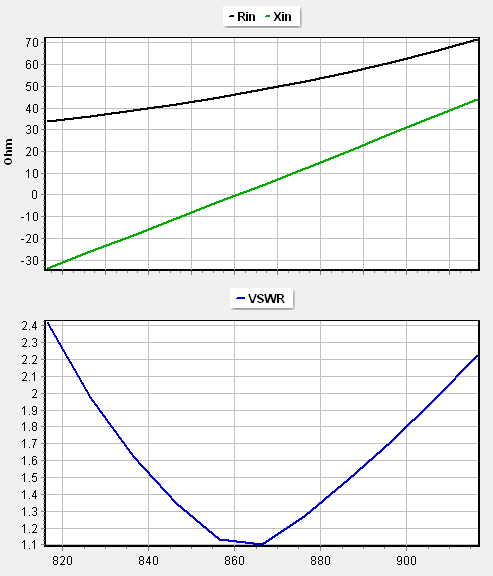
The antenna performance was evaluated using a frequency sweep from $816.5 \text{ MHz}$ to $916.5 \text{ MHz}$. The simulation captures the transition of the antenna through its resonant state, revealing a highly stable impedance profile (Fig. 3).
- Input Impedance: At the target frequency of $866.5 \text{ MHz}$, the calculated input impedance is $48 + j5\, \Omega$. This results in a Voltage Standing Wave Ratio (VSWR) of $1.1$, indicating an nearly perfect match to a standard 50-Ohm feedline.
- Impedance Dynamics: Throughout the sweep, the input resistance varies between $35$ and $70$ Ohms, while the reactance ranges from $-35$ to $+45$ Ohms (series resonance at $866.5 \text{ MHz}$). This smooth variation, typical of a series resonance, demonstrates the “wideband” nature of the biquad compared to narrow-band patches that operate around a parallel resonance.
- Operating Bandwidth: For a VSWR threshold of $\le 2$, the antenna exhibits an operational bandwidth of $85 \text{ MHz}$ (approximately $10\%$). This bandwidth is sufficient to cover the entire European LoRaWAN and RFID spectrum without requiring additional tuning.
Radiation Pattern and Far-Field Performance
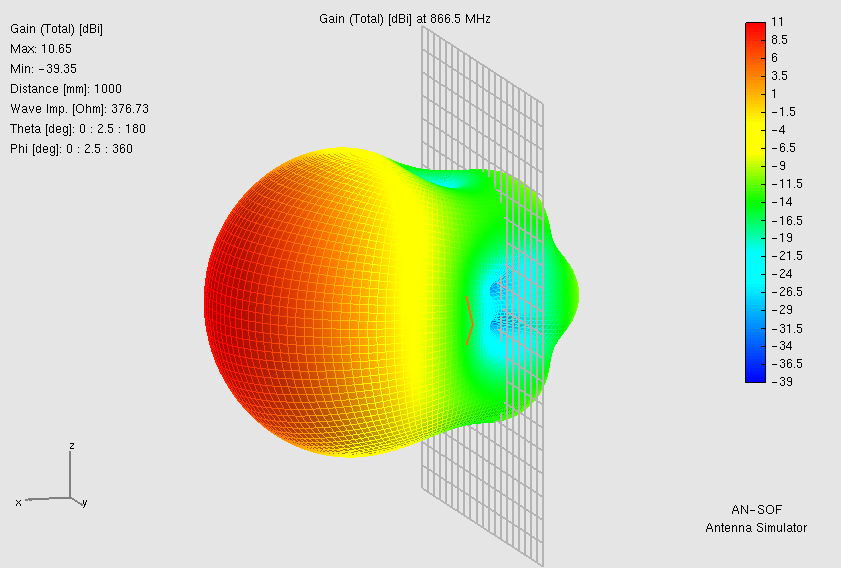
One of the most striking features of the Biquad with a reflector is the high degree of symmetry in its radiation characteristics. The simulation reports a gain that remains remarkably constant across the band, averaging $10.5 \text{ dBi}$.
Pattern Symmetry and Beamwidth:
The main lobe is well-defined and points perpendicularly away from the reflector (Fig. 4). A key advantage of this design is its rotational symmetry; the half-power beamwidths (HPBW) in both the vertical and horizontal planes are identical at $55^\circ$. This symmetry is particularly beneficial for applications where the orientation of the receiving antenna might fluctuate, as it ensures a consistent signal link budget.
Sidelobe and Backlobe Suppression:
The design eliminates secondary forward-pointing lobes, focusing all energy into a single aperture. Due to the optimized reflector size, the Front-to-Back (F/B) and Front-to-Rear (F/R) ratios are maintained at approximately $20 \text{ dB}$. While some back radiation exists due to edge diffraction at the $380 \text{ mm}$ plate, the isolation is more than sufficient for mounting the antenna on walls or masts without significant interference from rearward objects.
Practical Applications at 866.5 MHz
The 866.5 MHz frequency is a critical window within the EU863-870 MHz band. The 10.5 dBi gain of this Biquad antenna makes it a powerful tool for several key industries:
- LoRaWAN and LPWAN Gateways: In IoT (Internet of Things) deployments, gateways often need to reach sensors located several kilometers away. This antenna’s 10.5 dBi gain can significantly extend the range of a LoRa gateway compared to a standard omnidirectional whip antenna, especially in sectorized coverage or point-to-point relay links.
- UHF RFID Systems: The 865–868 MHz range is used for passive RFID tag reading. The rotational symmetry of the Biquad’s beamwidth is ideal for “portal” style readers where tags pass through a specific area. The high gain ensures that even small, low-power tags can be energized and read from a distance.
- Industrial Telemetry: For SCADA systems and remote industrial monitoring, the Biquad offers a robust, high-directivity solution that is less sensitive to nearby metallic structures than a Yagi-Uda antenna, thanks to its wide-aperture reflector.
Conclusion
The Biquad antenna with a planar reflector is a highly efficient aperture-style radiator that balances high gain with ease of matching. By achieving 10.5 dBi gain and a 10% bandwidth with a VSWR of 1.1, this design provides a “plug-and-play” solution for the 866.5 MHz band. Its symmetrical radiation pattern and high F/B ratio make it one of the most reliable directional antennas in the “Apertures and Reflectors” category of modern CEM study.
See Also:
Technical Keywords: Biquad Antenna, Harchenko Radiator, Planar Reflector, 866.5 MHz, ISM Band, LoRaWAN, UHF RFID, Impedance Matching, Front-to-Back Ratio.