
Antennas and Beyond!
This is a blog dedicated to exploring the fascinating world of antenna design and simulation. Whether you’re a beginner or an experienced engineer, you’ll find valuable insights into antenna modeling, theory, numerical methods, and practical examples of antenna models using AN-SOF Antenna Simulation Software.
Featured
-
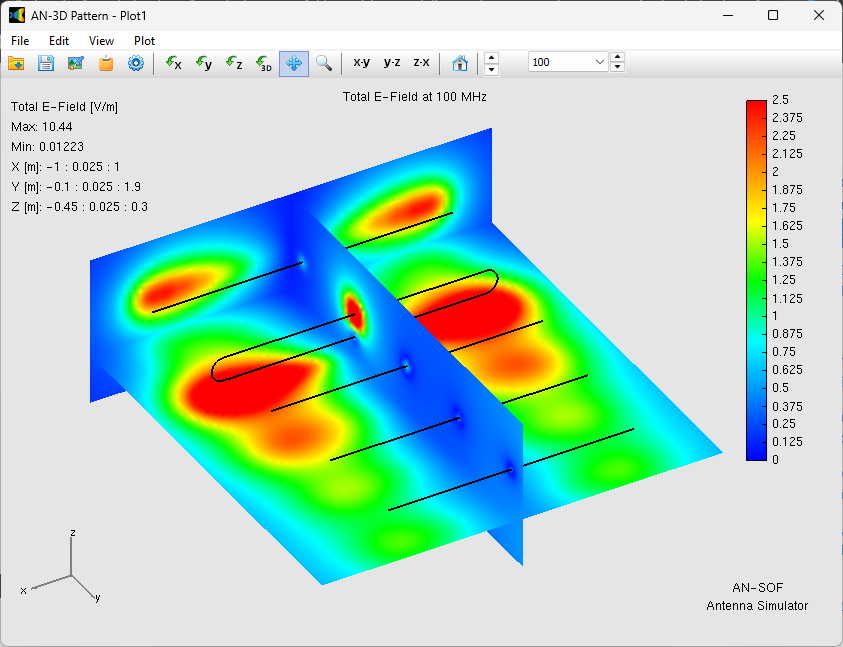
Introducing AN-SOF 11: Precision Modeling and Next-Gen Electromagnetic Simulation
We are thrilled to announce the release of AN-SOF Antenna Simulator Version 11. This landmark update introduces major advancements in our core electromagnetic solver, significantly expands the modeling CAD toolbox, and delivers highly requested visualization tools for RF engineers, academic researchers, and antenna design enthusiasts.
-
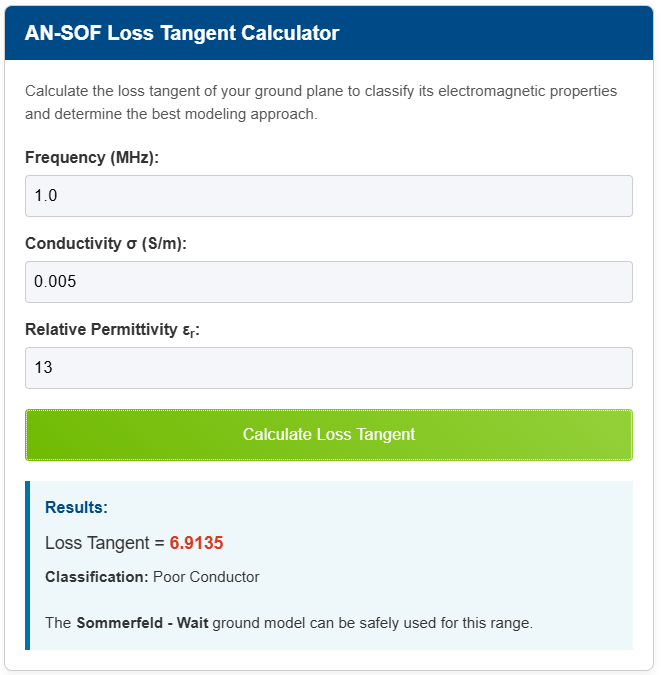
How to Select the Right Ground Plane Model
In computational electromagnetics, ‘one size does not fit all.’ The transition between a ground acting as a good dielectric versus a good conductor is governed by the Loss Tangent. This article provides a practical guide with embedded calculation and selection tools to select the most appropriate real ground plane model below an antenna elevated or…
-
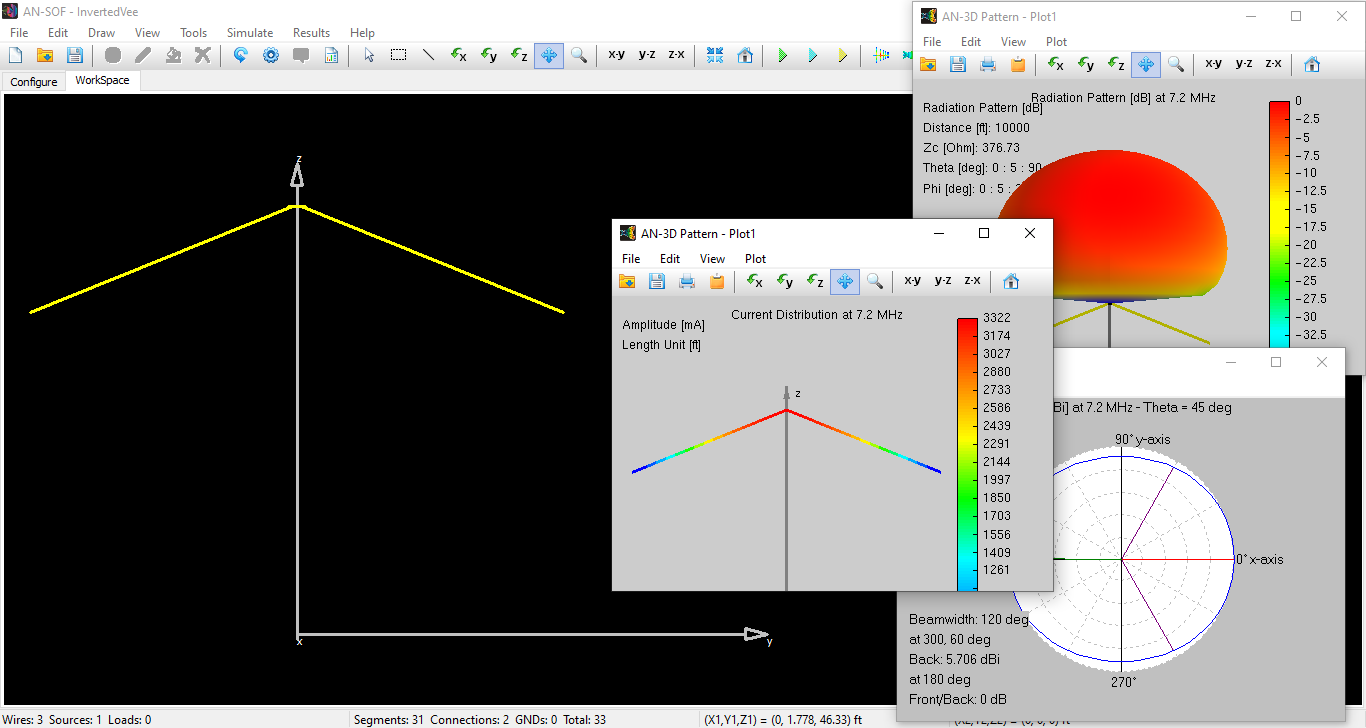
Modeling an Inverted V Antenna for 40 Meters: Design Insights and Ground Effects
The Inverted V antenna is a cornerstone of HF communication, providing a space efficient and single mast supported alternative to the horizontal dipole. This guide examines the critical influence of the antenna height above ground on its radiation pattern. Furthermore, we demonstrate how to use AN-SOF to accurately model the feedpoint at the antenna apex,…
Join a Global Community of RF Experts
Our technical insights are trusted by engineers and antenna enthusiasts at top-tier firms and research institutions. See how they use AN-SOF →
Sections
The Antenna Lab
Unlock the world of antenna design! This section offers engaging resources for educators and students, fostering a deeper understanding of antenna theory and practice.
The Ham’s Corner
Take your ham radio skills to the next level! This section offers practical tips, tutorials, and project ideas specifically designed for the needs and interests of radio enthusiasts.
Advanced RF Edge
Delve into the cutting edge of antenna design. This section explores industry trends, insightful case studies, and advanced technical insights to empower antenna professionals.
Categories
1. Ideal Antennas 2. Antenna Metrics 3. Linear Antennas 4. Advanced Antennas 5. Simulation Methods Adding Wire Grids and Solid Surfaces Adding Wires Antenna Feeder Calculator Apertures & Reflectors Array Antennas Background Theory Book Complex Environments Current Distribution Curved Antennas Displaying Results Drawing Wires Editing Wires FAQs Far-Field Fractal Antennas Getting Started Grids and Surfaces Ground Planes Guides Guides & Tools Helical Antennas Incident Field Input Impedances Linear Antennas Load Impedances Loop Antennas Microstrip Antennas Modeling Guidelines Models Near-Field Numerical Methods Release Notes Results Display Running Calculations Scripts & Optimizers Setup Guides Simulation Setup Sources and Loads Step By Step Transmission Lines Traveling Wave Validation Wire Antennas
Tags
advanced RF (30) antenna arrays (19) antenna design (19) antenna lab (39) blog (107) broadband (2) dipole (17) directional (27) featured (3) fractal (3) ham radio (24) helix (8) loop (18) microstrip (4) monopole (9) multiband (4) omnidirectional (17) quad (3) release notes (13) tips & tricks (15) transmission lines (5) validation (10) yagi (7)
Search our Knowledge Base
Search for answers or browse our Knowledge Base.
Recent Articles
-
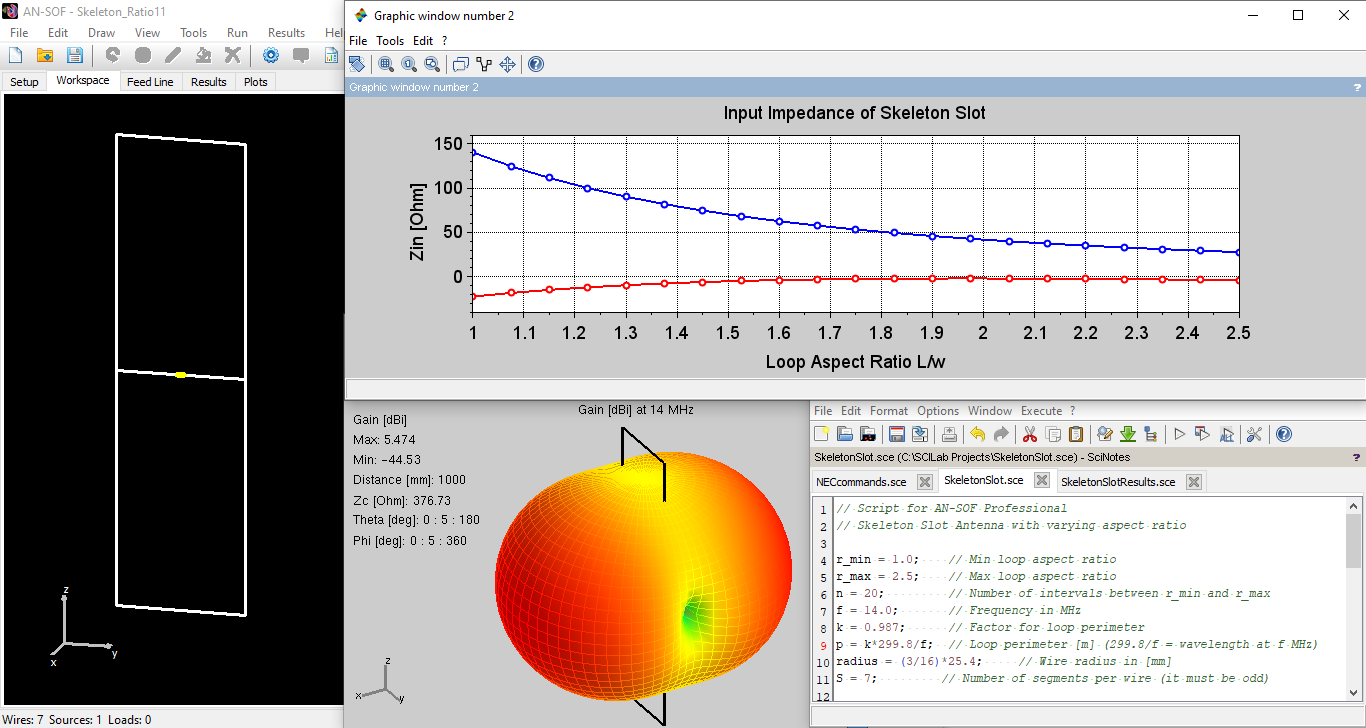
Design Guidelines for Skeleton Slot Antennas: A Simulation-Driven Approach
Dive into the intricacies of Skeleton Slot antennas. Explore optimal designs, balancing geometry parameters, and leveraging simulation tools. Ideal for both engineers and enthusiasts!
-

AN-SOF 8.70: Enhancing Your Antenna Design Journey
Experience antenna design at its best with AN-SOF 8.70, your comprehensive tool for simulation mastery.
-

Simple Dual Band Vertical Dipole for the 2m and 70cm Bands
Discover the perfect balance: a simple dual-band vertical dipole, AN-SOF modeling, and real-world results. Elevate your ham radio experience.
-
A Simple, Low-Cost Approach to Simulating Solid Wheel Antennas at 2.4 GHz
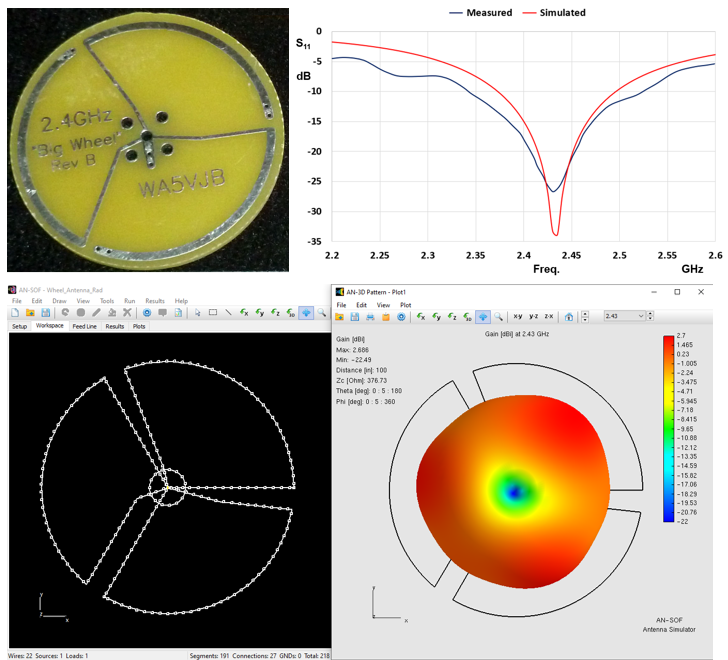
Explore a simple, low-cost method to simulate 2.4 GHz solid wheel antennas with reliable first-order accuracy and practical efficiency.
-

Transmission Line Feeding in Antenna Design: Exploring the Four-Square Array
Explore the Four-Square Array: a phased array using six transmission lines in its feeding system. Perfect for directional control, it combines simplicity and performance for RF engineers, ham operators, and antenna designers.
-
Simplified Modeling of Microstrip Antennas on Ungrounded Dielectric Substrates: A Practical First-Order Approach
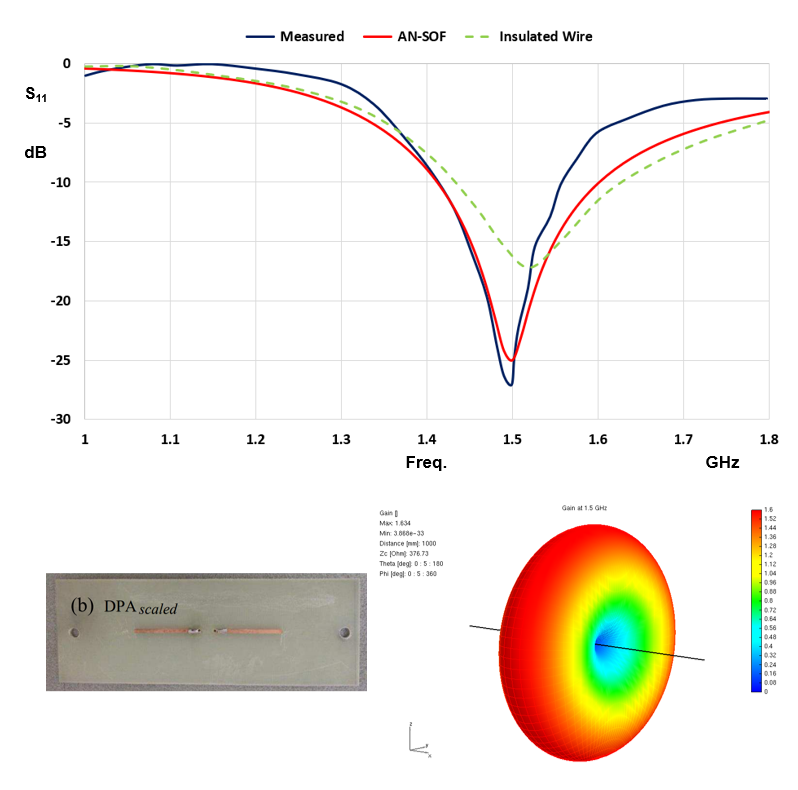
Discover a practical first-order method for modeling microstrip antennas on ungrounded dielectric substrates with simplicity and ease.
-
Fast Modeling of a Monopole Supported by a Broadcast Tower
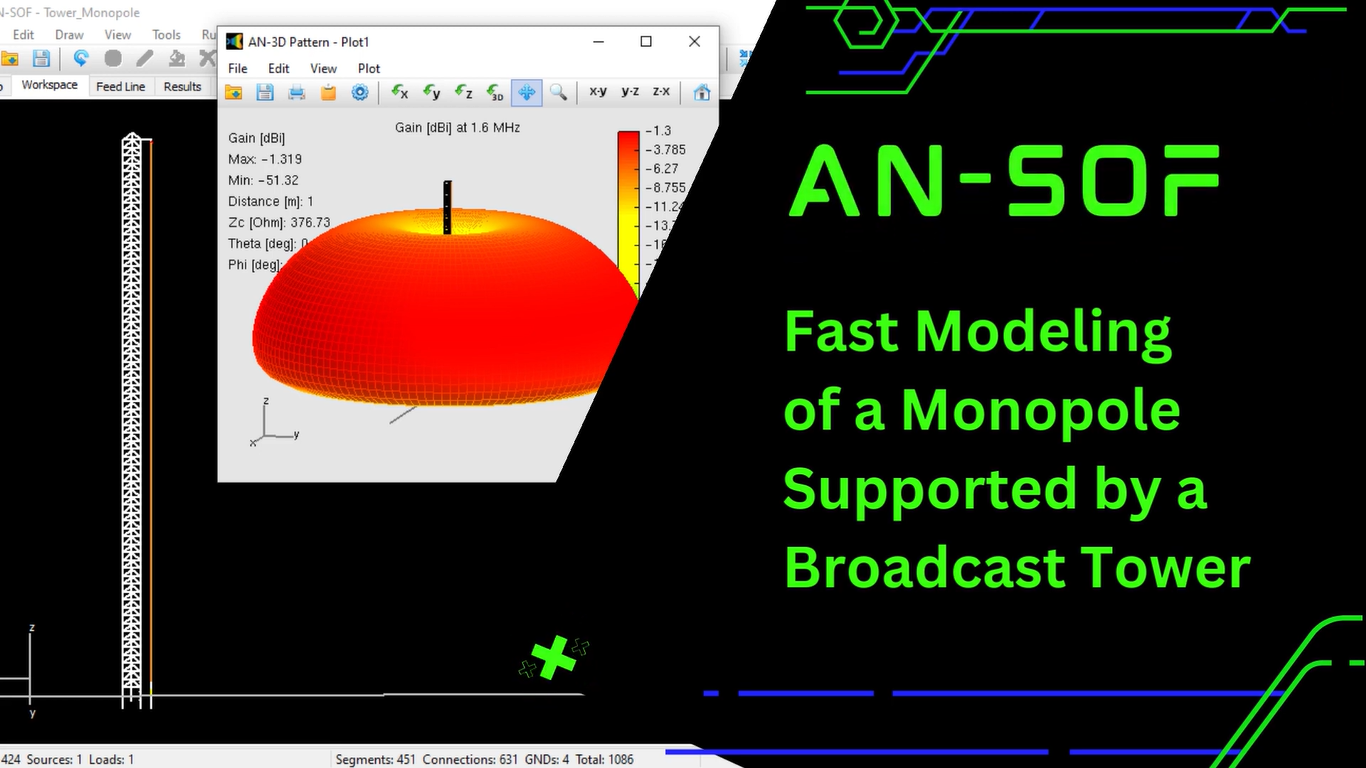
Elevate your antenna design game with our latest video tutorial on monopole modeling using AN-SOF.
-

Linking Log-Periodic Antenna Elements Using Transmission Lines
Dive into the world of advanced antenna design with our latest tutorial! Discover the art of connecting Log-Periodic Antenna Elements using Transmission Lines in the AN-SOF Antenna Simulator.
-

Introducing AN-SOF 8.50: Enhanced Antenna Design & Simulation Software
Embrace the antenna revolution with AN-SOF 8.50! Unleash its advanced features: Transmission Line models, expanded power budget, and precise far-field calculation. Free trial available!
-
Get Ready for the Next Level of Antenna Design: AN-SOF 8.50 is Coming Soon!
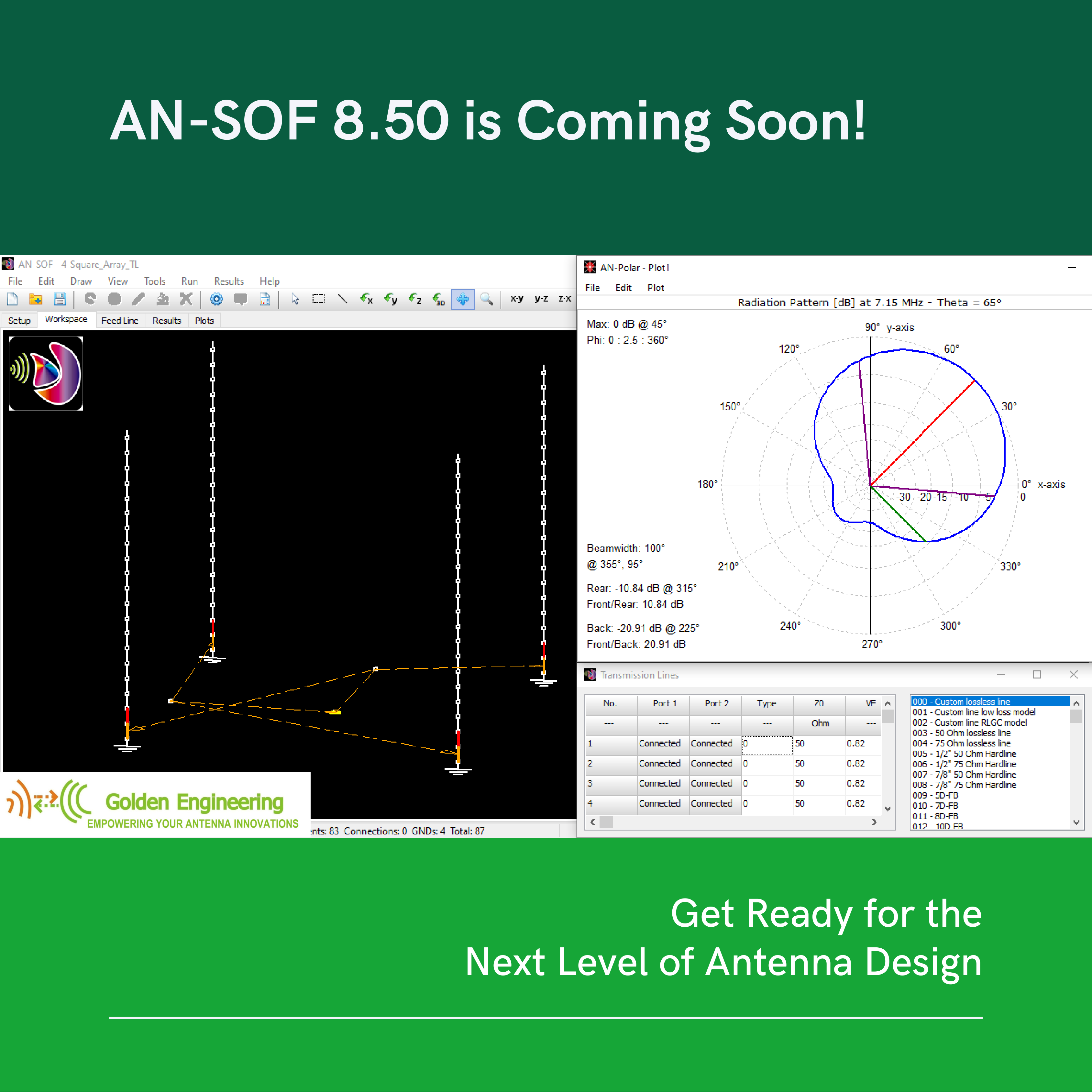
Get ready for the future of antenna design. AN-SOF 8.50 brings enhanced features like Transmission Line models, extended power budget, and improved far-field calculation. Stay tuned for the release!
-

Beyond NEC: Accurate LF/MF Grounding with the James R. Wait Model
Discover the competitive advantage of AN-SOF’s exclusive James R. Wait ground model. This guide explores how to accurately simulate LF/MF broadcast masts with radial wire ground screens, allowing for direct wire-to-ground connections, a critical feature for realistic impedance and efficiency calculations that legacy NEC-based solvers cannot match.
-
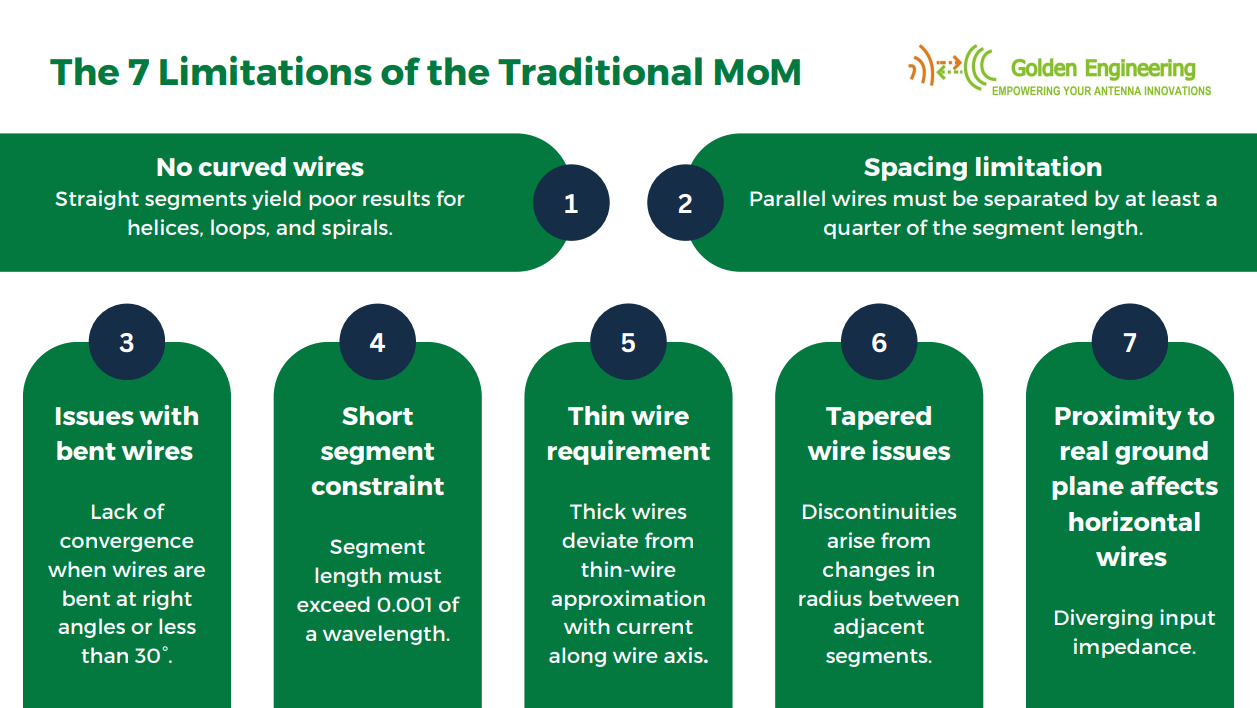
The 7 Limitations of Traditional MoM — and Why Measurement-Grade Conformal MoM Exists
Traditional Method of Moments codes still carry geometric and numerical constraints that degrade accuracy on the antennas professionals actually design. Conformal MoM with Exact Kernel removes them.
-
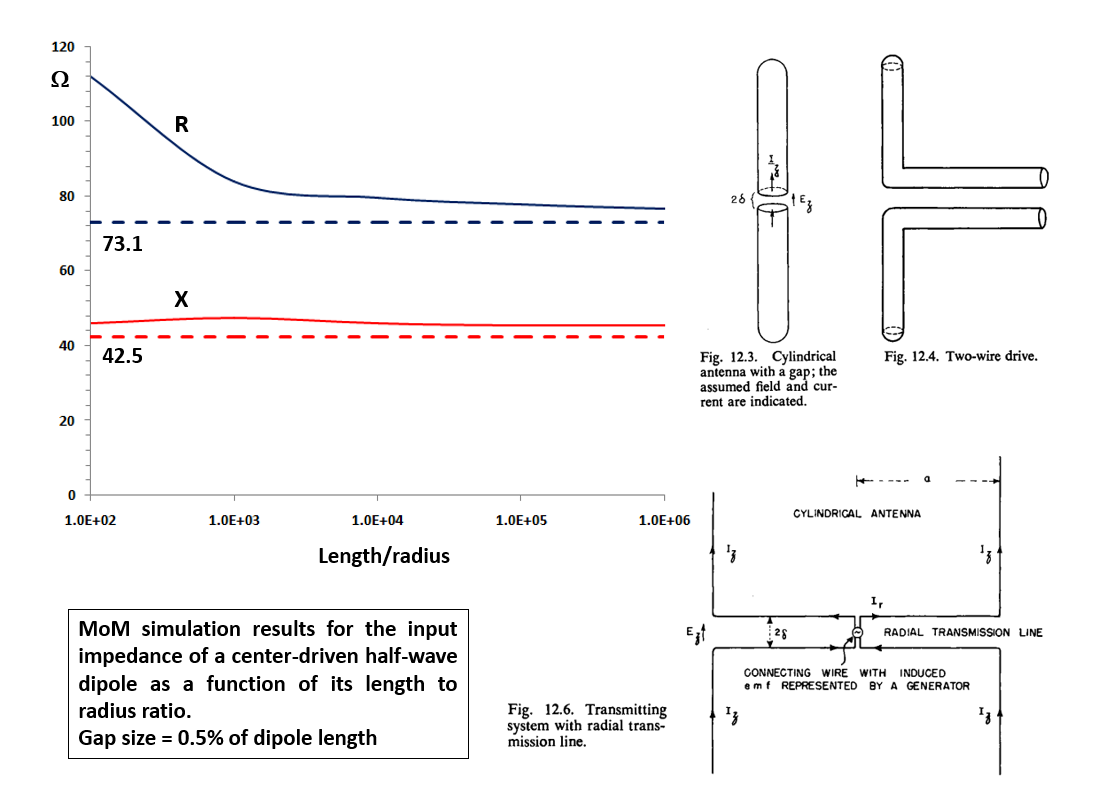
Linear Antenna Theory: Historical Approximations and Numerical Validation
Discover the vital role of historical theoretical results alongside advanced numerical calculations in accurately approximating current distribution on linear antennas.
-

Wave Matching Coefficient: Defining the Practical Near-Far Field Boundary
Discover how the Wave Matching Coefficient (WMC) redefines near-far field boundaries. Using a 20 dB threshold, we uncover new distances for elementary antennas and a consistent method to define non-spherical boundaries for antennas of any size or complexity relative to the wavelength.
-
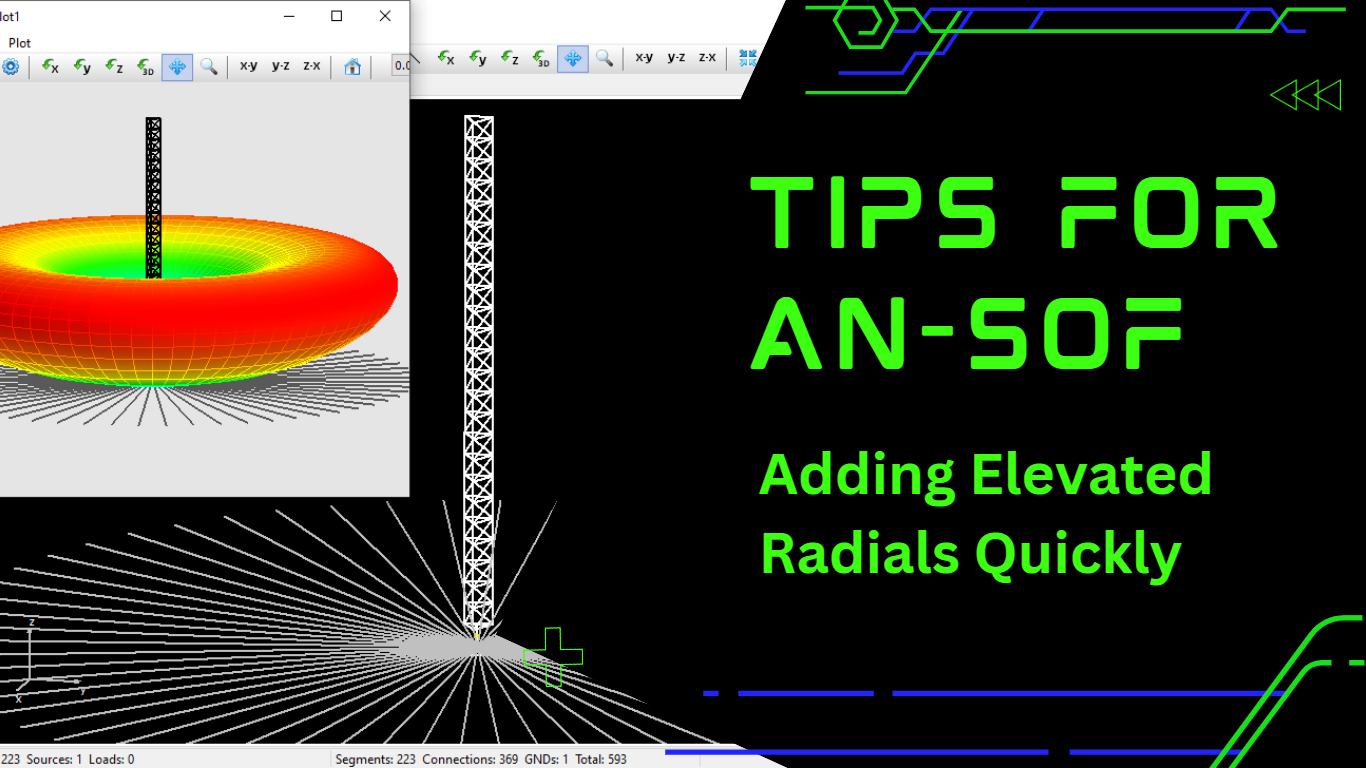
AN-SOF Mastery: Adding Elevated Radials Quickly
Rev up your AN-SOF skills with this video tutorial featuring two fast methods for adding elevated radials.
-

Front-to-Rear and Front-to-Back Ratios: Applying Key Antenna Directivity Metrics
Understand the difference between Front-to-Rear (F/R) and Front-to-Back (F/B) ratios, key metrics for antenna directivity. Learn how to calculate and interpret these values using AN-SOF software. Improve your antenna designs with this essential knowledge.
-
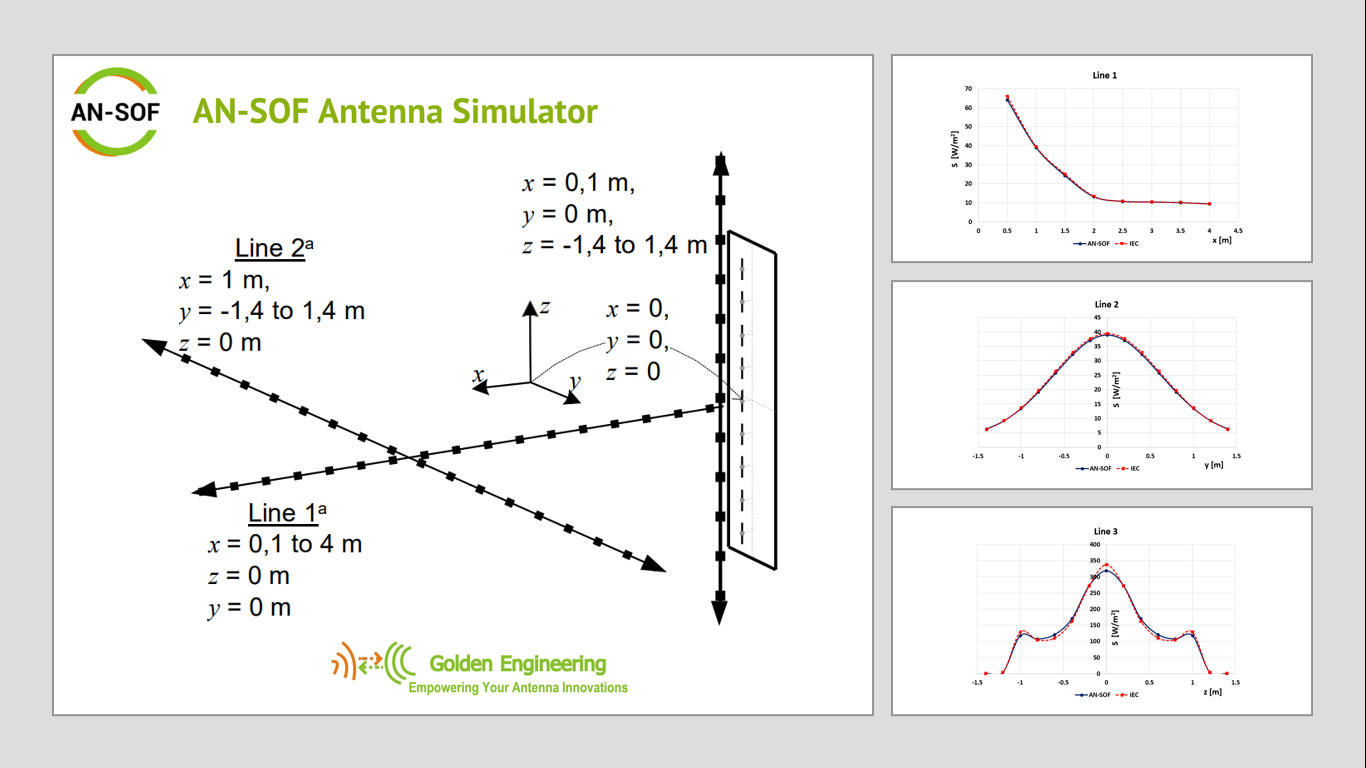
Validation of a Panel RBS Antenna with Dipole Radiators against IEC 62232 Standard
This article validates AN-SOF’s results against the IEC FDIS 62232 standard by replicating an RBS panel antenna model with nine dipole radiators. The successful validation highlights AN-SOF’s ability to deliver highly accurate results, even with relatively simple models.
-
Upgrade to AN-SOF 8.20 – Unleash Your Potential
The latest release of AN-SOF, version 8.20, introduces significant infrastructure enhancements designed to improve both the accessibility of the software and the raw performance of its numerical engine. This update streamlines the user experience by centralizing core dependencies and refining the interaction between the engineer and the simulation results.
-
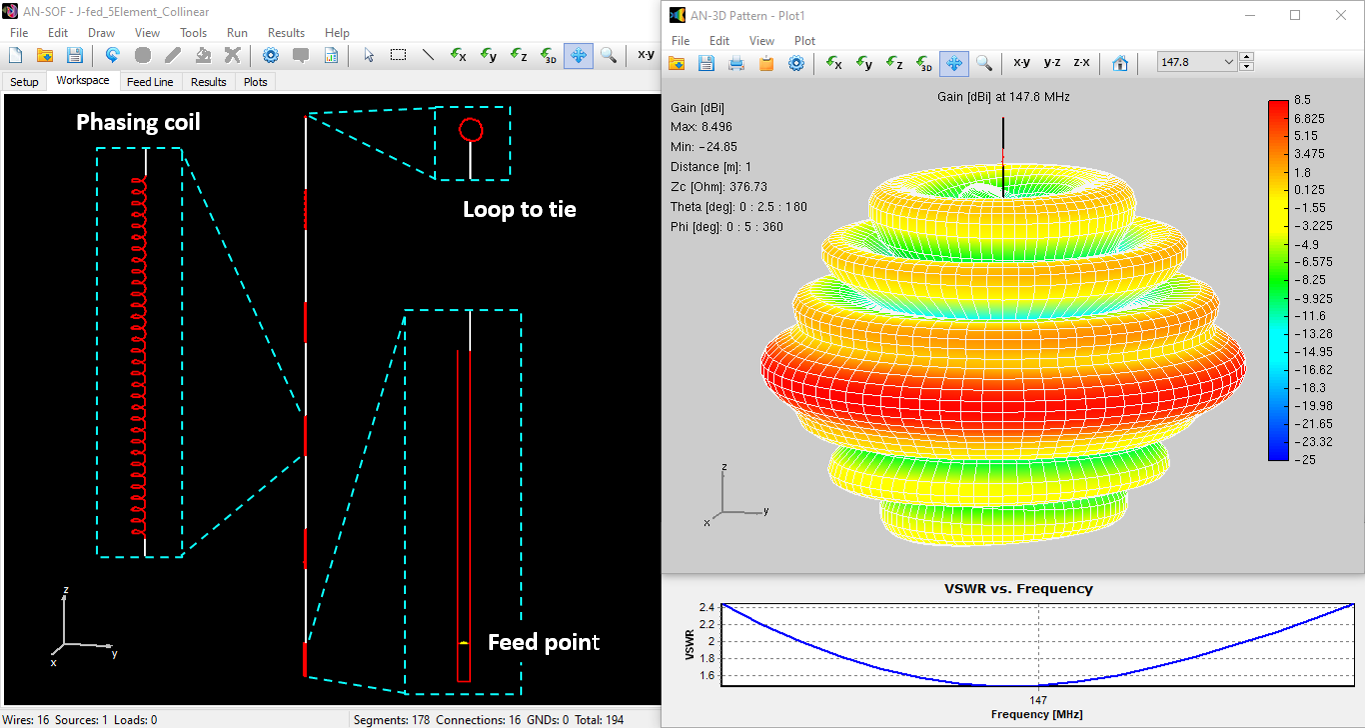
Modeling a Super J-Pole: A Look Inside a 5-Element Collinear Antenna
Simulating a Super J-Pole: A 2m Antenna Analysis. This article describes a 5-element collinear antenna design for the 2m band, its radiation pattern, VSWR, and key components for optimal performance.
-
AN-SOF 8: Elevating Antenna Simulation to the Next Level
The release of AN-SOF 8 represents a major leap in post-processing efficiency and workspace ergonomics. This version introduces streamlined data visualization tools and intuitive navigation features designed to accelerate the antenna design-to-verification workflow.
-
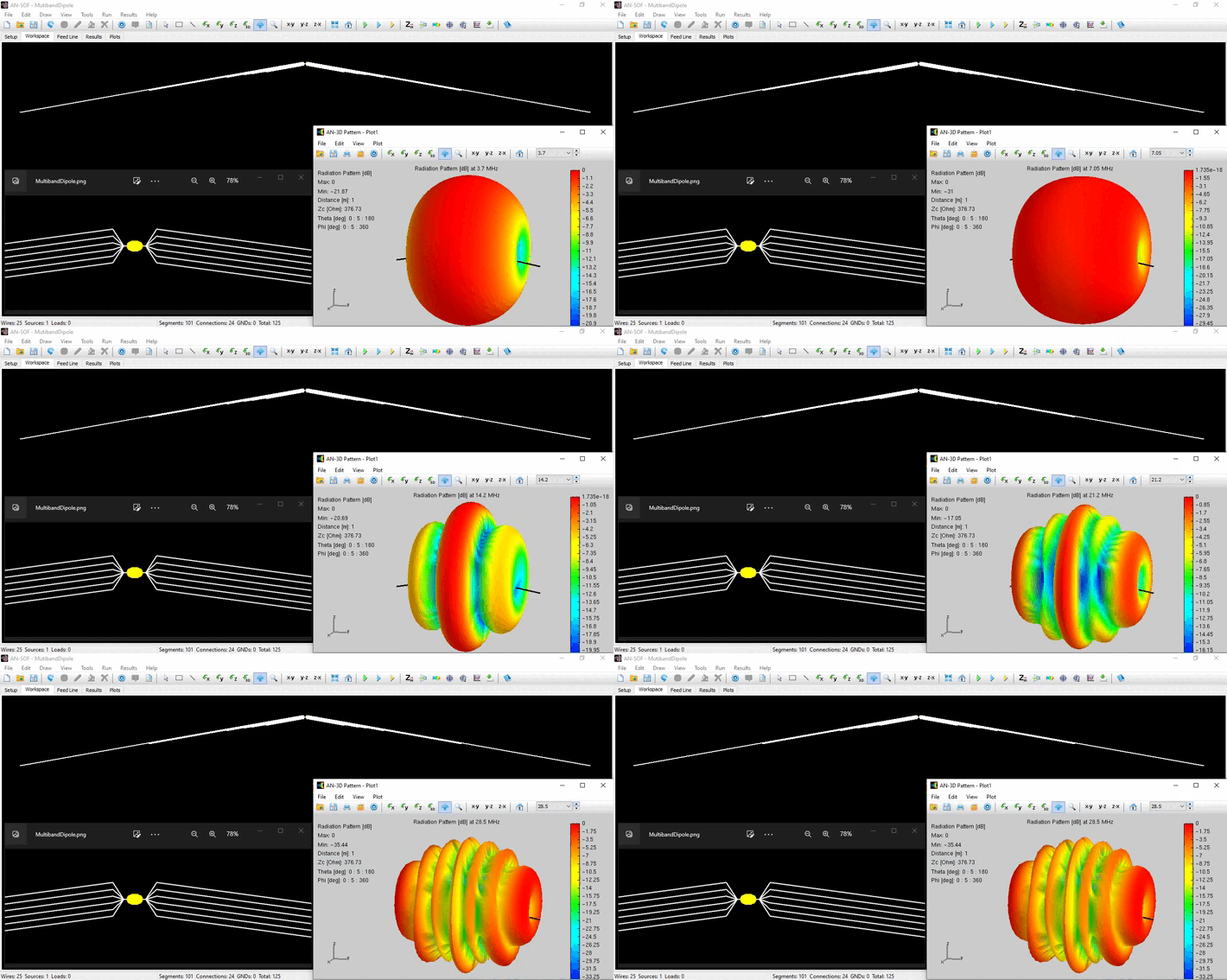
Simulating a Multiband Omnidirectional Dipole Antenna Design
Discover the design and simulation of a multiband omnidirectional dipole antenna using AN-SOF. Operating at six key frequencies, this antenna combines closely spaced parallel dipoles into a single feed point. Explore how simulation reveals performance patterns and empowers your antenna experiments.
-
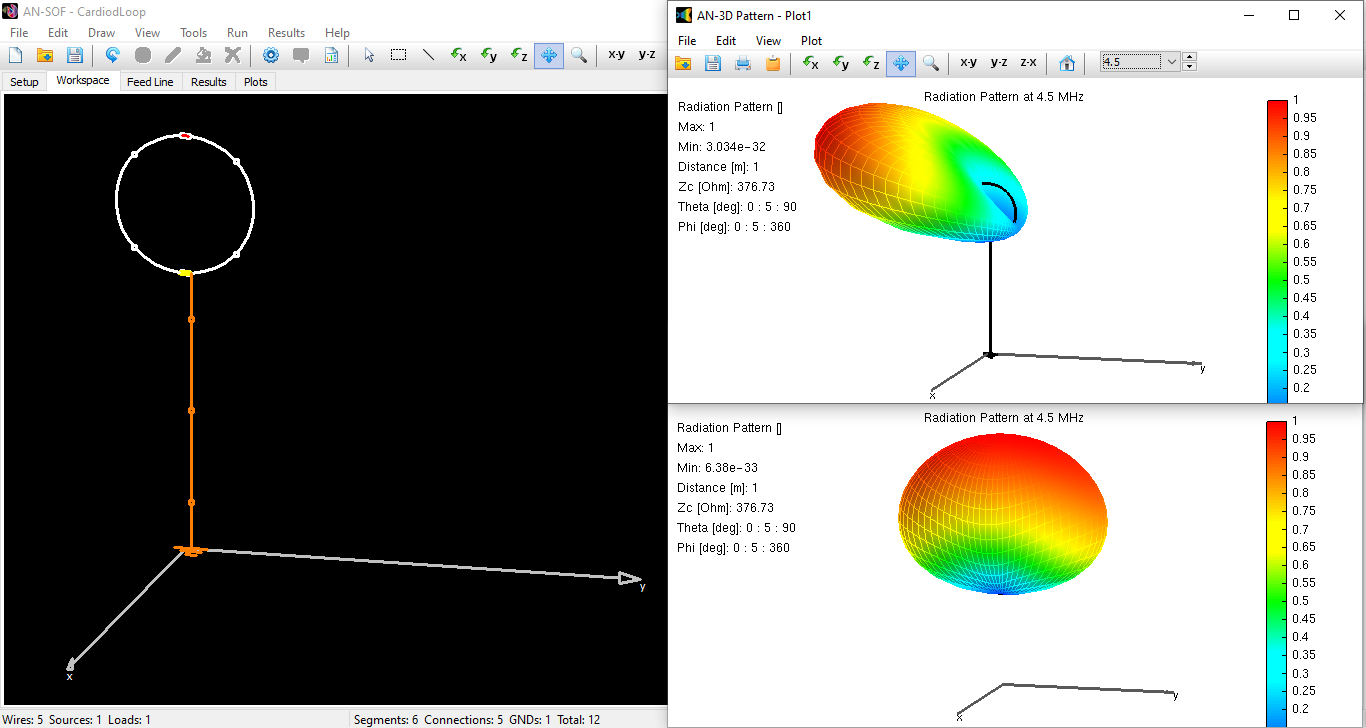
The Loop on Ground (LoG) Antenna: A Compact Solution for Directional Reception
The Loop on Ground (LoG) antenna offers a compact solution for directional reception with a cardioid radiation pattern. This article explores its design and highlights the efficiency achieved through the Conformal Method of Moments (CMoM).
-
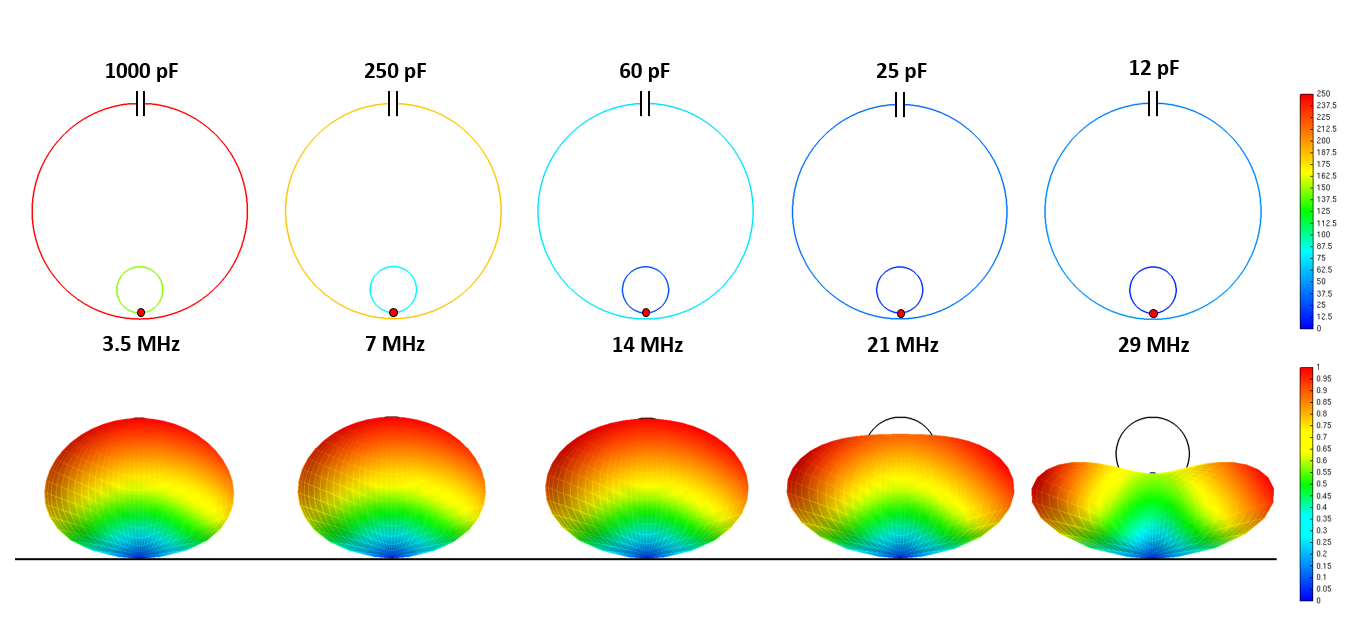
Precision Simulations with AN-SOF for Magnetic Loop Antennas
Explore magnetic loop antenna design and simulation with AN-SOF. Model performance at five frequencies, showcasing radiation patterns, current distributions, and tuning values. Automated bulk simulations streamline the process.
-
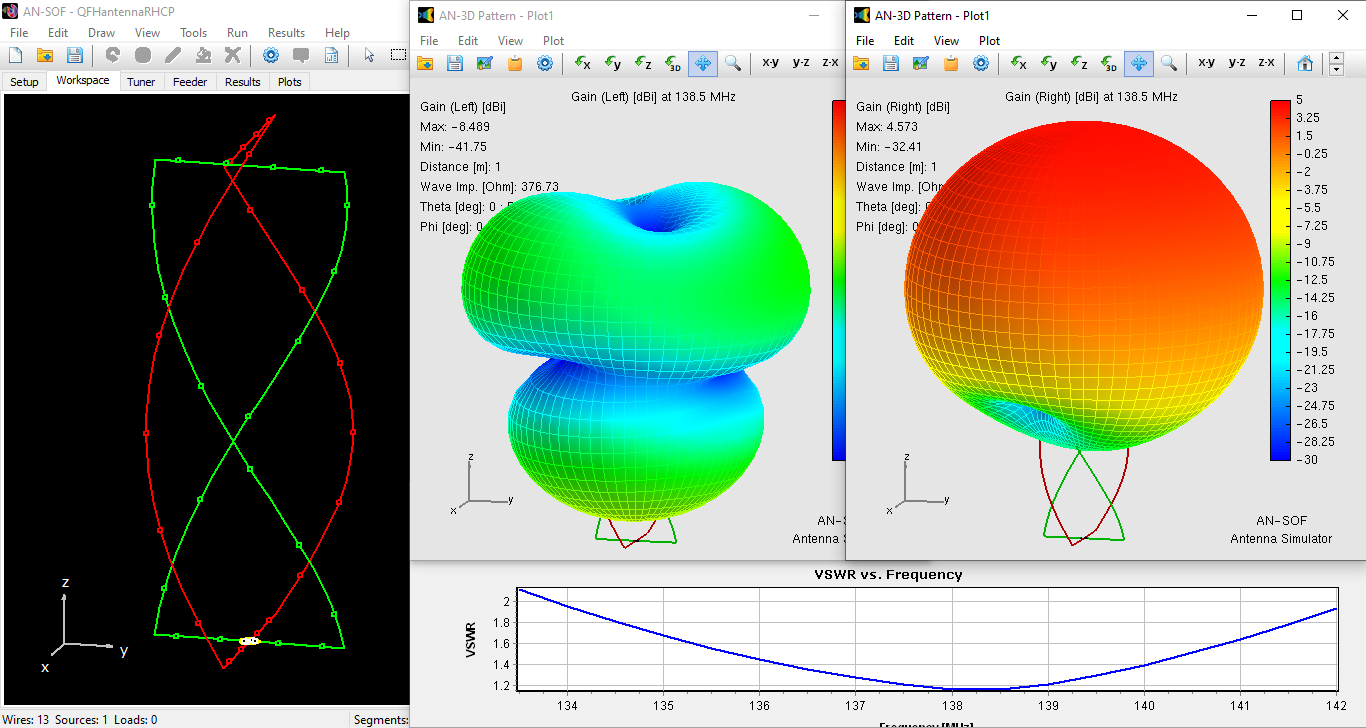
Efficient LEO and Weather Satellite Signal Reception with the Quadrifilar Helix Antenna
The Quadrifilar Helix antenna (QFH or QHA), through its specialized geometry, ensures robust reception for modern LEO satellite data links, providing high-quality imagery from polar-orbiting weather systems even at low elevation angles. This article explores the history, key characteristics, and practical modeling of QFH antennas using AN-SOF, providing valuable insights for RF engineers and enthusiasts.
-
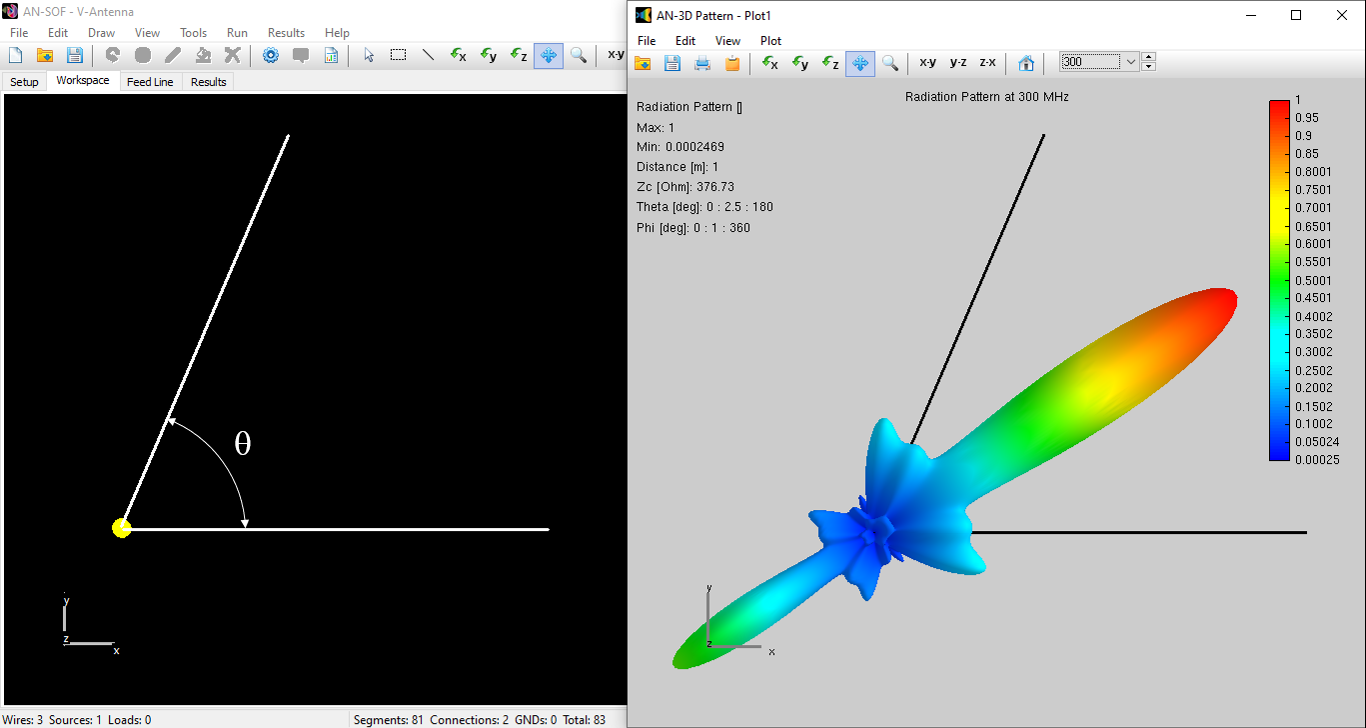
Validating V Antennas: Directivity Analysis with AN-SOF
This article validates AN-SOF’s results against established formulas for V antennas, highlighting its advanced modeling capabilities. We explore optimal angles, directivity enhancements, and precise calculations, making AN-SOF a powerful tool for RF engineers, ham radio enthusiasts, and antenna designers.
-
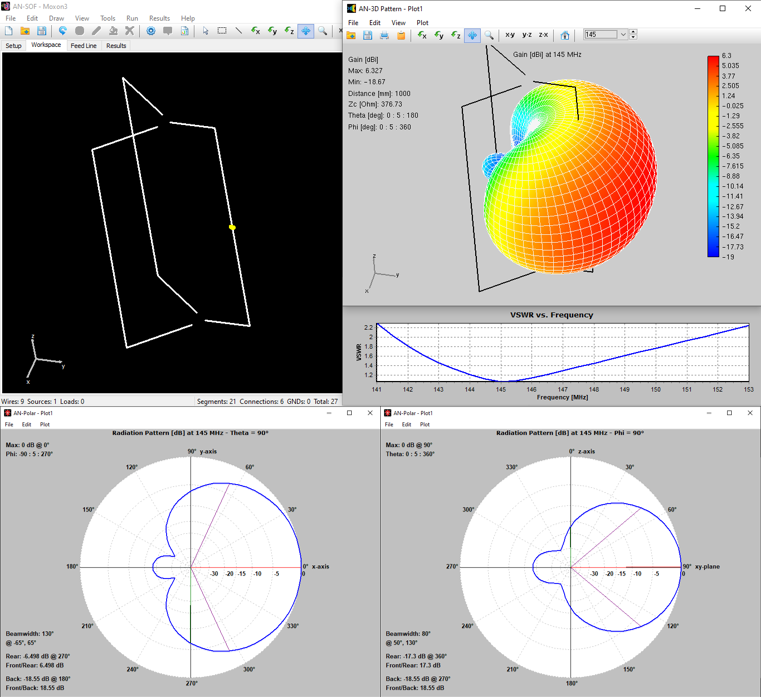
Enhancing VHF Performance: The Dual Reflector Moxon Antenna for 145 MHz
Discover the Dual Reflector Moxon Antenna at 145 MHz (2m band): Amplified Gain and Enhanced Performance for VHF Enthusiasts.
-
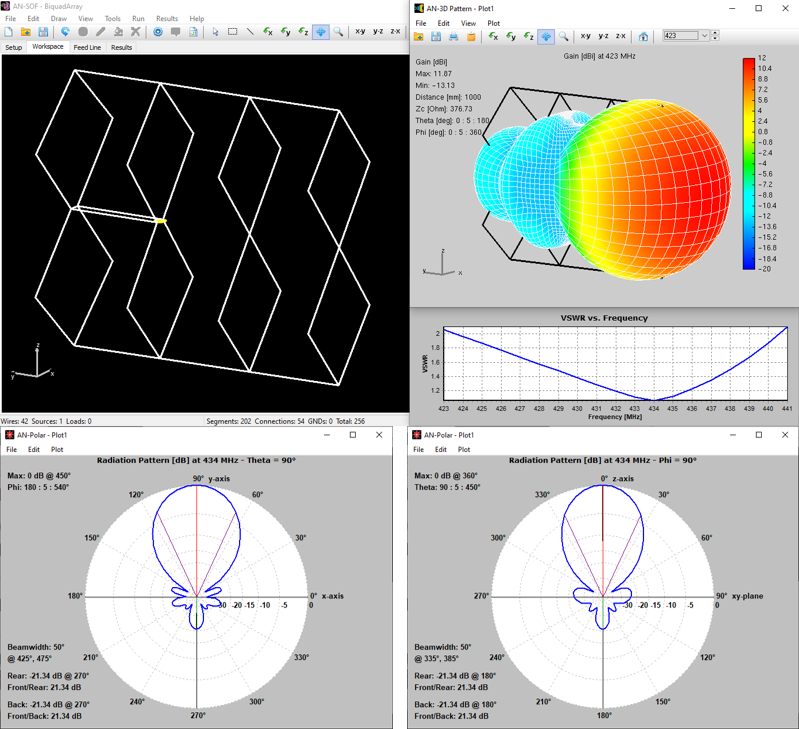
Building a Compact High-Performance UHF Array with AN-SOF: A 4-Element Biquad Design
Need a compact directional antenna for your UHF needs? This 4-element Biquad antenna, designed with AN-SOF, packs a powerful punch in a relatively small space. Perfect for UHF applications where space is at a premium!
-
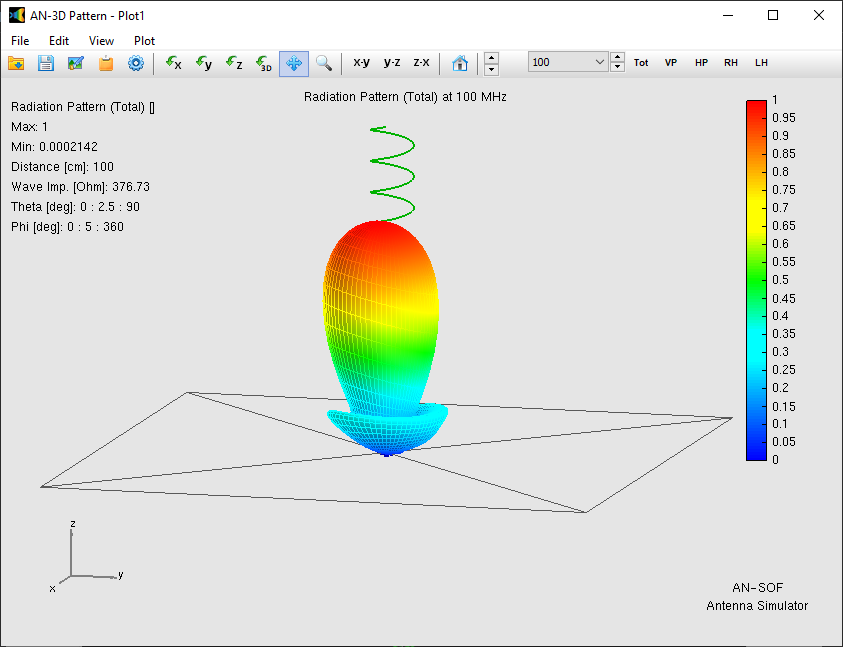
Validating AN-SOF Simulations for Gain and VSWR of Helix Antennas in Axial Mode
AN-SOF simulations of axial-mode helical antennas closely match John D. Kraus’s classic measurements for gain and VSWR, confirming its accuracy. Using the Conformal Method of Moments, AN-SOF models true helix curvature, delivering reliable predictions for high-gain circularly polarized designs.
-
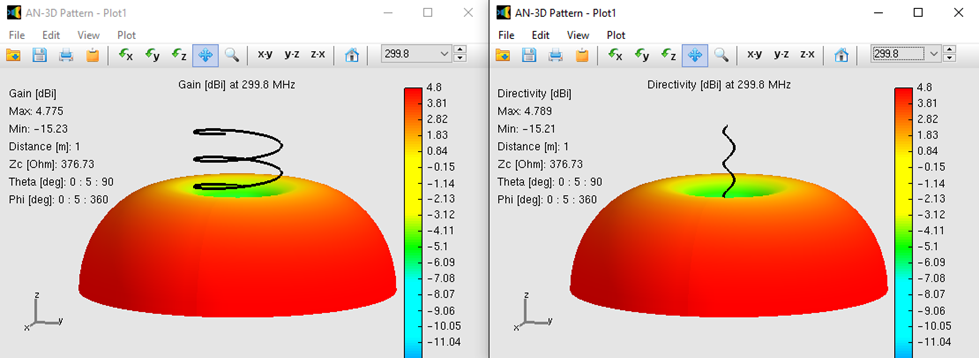
Helical Antennas in Normal Mode: Theoretical Limits and Numerical Validation
Validate the electromagnetic behavior of the helical antenna in its Normal Mode through this detailed study referencing the foundational work of John D. Kraus. By analyzing the transition from a 3D helical structure to its theoretical loop-dipole equivalent, this article demonstrates how AN-SOF accurately captures the broadside radiation pattern and the asymptotic gain limit. Essential…
-
Input Impedance and Directivity of Large Circular Loops: Theory vs. Numerical Simulation
Moving beyond the uniform-current simplifications of small antennas, this article analyzes the electromagnetic behavior of electrically large circular loops. By benchmarking AN-SOF numerical results against classical Fourier theory, we explore how loop circumference and wire thickness influence non-uniform current distributions, parallel/series resonances, and axial directivity. This detailed study validates the accuracy of CMoM for curved…

Join a Global Community of RF Experts
Our technical insights are trusted by engineers and antenna enthusiasts at top-tier firms and research institutions. See how they use AN-SOF →
Indexed Articles
- 1.3 Arrays of Point Sources
- Aborting the Calculations
- A Closer Look at the HF Skeleton Slot Antenna
- Adding a Dielectric Substrate
- Adding a Feed Line and Transformer
- Adding a Custom Lossy Line
- Adding a PEC Ground Plane
- Adding a Real Ground Plane
- Adding Loads
- Adding Sources
- Adding Transmission Lines
- Advanced Modeling of Monopoles over Radial Wire Ground Screens
- Advantages of AN-SOF for Simulating 433 MHz Spring Helical Antennas for ISM & LoRa Applications
- Analyzing the Internal Impedance of a Source
- An Efficient Approach to Simulating Radiating Towers for Broadcasting Applications
- AN-SOF 8.70: Enhancing Your Antenna Design Journey
- AN-SOF 8: Elevating Antenna Simulation to the Next Level
- AN-SOF 9.50 Release: Streamlining Polarization, Geometry, and EMF Calculations
- AN-SOF 9: Taking Antenna Design Further with New Feeder and Tuner Calculators
- AN-SOF Antenna Simulation Best Practices: Checking and Correcting Model Errors
- AN-SOF Antenna Simulation Software - Version 8.90 Release Notes
- AN-SOF Data Export: A Guide to Streamlining Your Workflow
- AN-SOF Engine User Guide
- AN-SOF in Action: Modeling and Understanding the Performance of Fractal Antennas
- AN-SOF Mastery: Adding Elevated Radials Quickly
- AN-SOF Overview
- AN-SOF User Guide
- Antenna Far-Field Comparison using Multi-Slice and Multi-Frequency Plots
- Arc
- Archimedean Spiral
- Articles Index Directory
- A Simple, Low-Cost Approach to Simulating Solid Wheel Antennas at 2.4 GHz
- Attributes of Grids and Surfaces
- Automating 2-Element Quad Array Design: Scripting and Bulk Processing in AN-SOF
- Automotive Antenna Placement: How Vehicle Geometry Reshapes FM Reception
- 5.2 Differential Equation Methods
- 2.6 Directivity and Gain
- Defining the Environment
- Defining the Excitation
- Deleting a Grid or Surface
- Deleting a Wire
- Deleting Multiple Wires
- Design and Analysis of a Parabolic Cylinder Reflector with a Back-Firing Primary Radiator
- Design and Simulation of a Compact Self-Resonant Pyramidal Horn Antenna for 2.4 GHz WiFi
- Design and Simulation of Short Top-Loaded Monopole Antennas for LF and MF Bands
- Design Guidelines for Skeleton Slot Antennas: A Simulation-Driven Approach
- Disclaimer of Warranty
- Disk
- Displaying Smith Charts
- DIY Helix High Gain Directional Antenna: From Simulation to 3D Printing
- Download Example Models
- 4.7 Fractal Antennas
- 2.8 Feedpoint Impedance and Bandwidth
- Far-Field Parameters
- Fast Modeling of a Monopole Supported by a Broadcast Tower
- Feeder Results: Input Impedance and Losses
- File Formats
- Flat Ring
- Fractal vs. Arbitrary Geometry: Analyzing the VE9SRB "Random" Loop
- Front-to-Rear and Front-to-Back Ratios: Applying Key Antenna Directivity Metrics
- 4.2 Helical Antennas
- 4.5 Horn Antennas
- 5.4 Hybrid Numerical Techniques
- 3.4 Hallén’s Integral Equation
- Helical Antennas in Normal Mode: Theoretical Limits and Numerical Validation
- Helix
- HF Maritime Platform Integration: Modeling a 10 MHz Naval Monopole Array
- High-Gain Biquad Antenna with Planar Reflector: Analysis and Applications for the 866.5 MHz ISM Band
- High-Performance Impedance Matching in Microstrip Antennas: The Role of Capacitive Feeding
- How to Adjust the Radiation Pattern Reference Point for Better Visualization
- How to Select the Right Ground Plane Model
- How to Speed Up Simulations in AN-SOF: Tips for Faster Results
- 5.3 Integral Equation Methods
- 5.1 Introduction to Antenna Simulation
- 3.3 Induced EMF Method
- 3.2 Input Impedance and Feedpoint Modeling
- Importing Wires
- Incident Field Parameters
- Input Impedance and Directivity of Large Circular Loops: Theory vs. Numerical Simulation
- Introducing AN-SOF 10.5 – Smarter Tools, Faster Workflow, Greater Precision
- Introducing AN-SOF 11: Precision Modeling and Next-Gen Electromagnetic Simulation
- Introducing AN-SOF 8.50: Enhanced Antenna Design & Simulation Software
- Introducing the AN-SOF Engine: Power, Speed, and Flexibility for Antenna Simulation
- Introduction to Yagi-Uda Arrays: Analyzing a 5-Element Beam with a Folded Dipole Driver
- 2.7 Beamwidth and Sidelobes
- Beyond Analytical Formulas: Accurate Coil Inductance Calculation with AN-SOF
- Beyond NEC: Accurate LF/MF Grounding with the James R. Wait Model
- Boosting Performance with Dual V Antennas: A Practical Design and Simulation
- Building a Beam: Modeling a 5-Element 2m Band Quad Array
- Building a Compact High-Performance UHF Array with AN-SOF: A 4-Element Biquad Design
- Building Effective Cost Functions for Antenna Optimization: Weighting, Normalization, and Trade-offs
- 3.1 Cylindrical Wire Antennas
- Calculating the Current Distribution
- Calculating the Far-Field
- Calculating the Near E-Field
- Calculating the Near H-Field
- Can AI Design Antennas? Lessons from a 3-Iteration Yagi-Uda Experiment
- Circle
- Circuit Theory Validation: Simulating an RLC Series Resonator
- Color of Grids and Surfaces
- Complete Workflow: Modeling, Feeding, and Tuning a 20m Band Dipole Antenna
- Cone
- Connecting Transmission Lines
- Connecting Wires
- Connecting Wires to the Ground
- Copying and Stacking Wires
- Cross-Section Equivalent Radius
- Curved vs. Straight Segments
- Custom Feed Line Options
- Custom Preferences
- Custom Transmission Lines
- Cylinder
- 2.11 Effective Aperture and Gain
- 3.6 Equivalent Radius for Non-Circular Wires
- Editing Loads
- Editing Sources
- Editing Transmission Lines
- Efficient LEO and Weather Satellite Signal Reception with the Quadrifilar Helix Antenna
- Electric Field Integral Equation
- Element Spacing Simulation Script for Yagi-Uda Antennas
- Enabling/Disabling Coating
- Enabling/Disabling Loads
- Enabling/Disabling Resistivity
- Energy Conservation and Gain Convergence in Cylindrical Dipoles: A Numerical Validation Study
- Enhancing Antenna Design Flexibility: Project Merging in AN-SOF
- Enhancing VHF Performance: The Dual Reflector Moxon Antenna for 145 MHz
- Evaluating EMF Compliance - Part 1: A Guide to Far-Field RF Exposure Assessments
- Evaluating EMF Compliance - Part 2: Using Near-Field Calculations to Determine Exclusion Zones
- Evolution of AN-SOF: New Features and Enhancements from Version 6.20 to 7.90
- Evolving Better Antennas: A Genetic Algorithm Optimizer Using AN-SOF and Scilab
- Excitation by an Incident Field
- Excitation of the Structure
- Experimenting with Half-Wave Square Loops: Simulation and Practical Insights
- Explicit Modeling of a 9-Element LPDA: Capturing Real-World Wideband Performance
- Explore 5 Antenna Models with Less Than 50 Segments in AN-SOF Trial Version
- Exploring an HF Log-Periodic Sawtooth Array: Insights from Geometry to Simulation
- Exploring the Spiral Loop Antenna: A Compact Solution for 80m DXing
- Exporting Currents on a Wire
- Exporting Radiation Patterns to MSI Planet Format: A Step-by-Step Guide
- Exporting Radiation Patterns to Radio Mobile: A Step-by-Step Guide
- Exporting the Far-Field
- Exporting the Near-Field
- Exporting Wires
- Extended Double Zepp (EDZ): A Phased Array Solution for Directional Antenna Applications
- 4.4 Log-Periodic Arrays
- 4.1 Loop Antennas
- Lab 1: Radiation & Ideal Physics
- Lab 2: Performance & Metrics
- Lab 3: Linear Antenna Design
- Lab 4: Advanced Architectures
- Lab 5: CEM & Simulation Pro
- Licensing FAQ
- Line
- Linear Antenna Theory: Historical Approximations and Numerical Validation
- Linking Log-Periodic Antenna Elements Using Transmission Lines
- Listing Load Impedances
- Listing the Currents in a Segment
- Listing the Input Impedances, VSWR, and S11
- Logarithmic Spiral
- 5.5 Method of Moments (MoM)
- 4.8 Microstrip and Printed Antennas
- 1.9 Monopole Antennas
- 1.1 Maxwell’s Equations and Electromagnetic Radiation
- Modeling a Center-Fed Cylindrical Antenna with AN-SOF
- Modeling a Circular Loop Antenna in AN-SOF: A Step-by-Step Guide
- Modeling an Inverted V Antenna for 40 Meters: Design Insights and Ground Effects
- Modeling a Super J-Pole: A Look Inside a 5-Element Collinear Antenna
- Modeling Coaxial Cables
- Modeling Common-Mode Currents in Coaxial Cables: A Hybrid Approach
- Modeling Helix Antennas in Axial Radiation Mode Using AN-SOF
- Modeling Lumped Loads in AN-SOF: Canceling Feedpoint Reactance for a Perfect Match
- Modifying a Grid or Surface
- Modifying a Wire
- Monopole Antennas Over Imperfect Ground: Modeling and Analysis with AN-SOF
- Moving, Rotating, and Scaling Wires
- 4.6 Parabolic Reflectors
- 2.2 Polarization
- 1.0 Preface & Table of Contents
- Paraboloid
- Patch
- Plate
- Plotting 2D Far-Field Patterns
- Plotting 3D Far-Field Patterns
- Plotting Near-Field Patterns
- Plotting the Current Distribution
- Plotting the Far-Field Spectrum
- Plotting the Near-Field Spectrum
- Power Budget
- Precision Modeling of Small Loop Antennas: Validating the Conformal Method of Moments (CMoM)
- Precision Simulations with AN-SOF for Magnetic Loop Antennas
- Project Details
- 2.3 Radiated Power and Energy Conservation
- 2.5 Radiation Efficiency
- 2.1 Radiation Pattern Fundamentals
- 2.4 Radiation Resistance
- 2.10 Receiving Mode Operation
- Radar Cross Section and Reception Characteristics of a Passive Loop Antenna: A Simulation Study
- Radar Cross Section (RCS)
- Rectangular Microstrip Patch Antennas: A Comparative Analysis of Transmission Line Theory and AN-SOF Numerical Results
- Removing the Ground Plane
- Resonant Radar Cross Section (RCS) Analysis of a Jet Trainer in the HF Band
- RF Calculators
- RF Techniques: Implicit Modeling and Equivalent Circuits for Baluns
- Running a Bulk Simulation
- 3.7 Self and Mutual Impedances
- Selecting and Modifying Multiple Wires
- Selecting a Wire
- Shortcut Keys
- Simple Dual Band Vertical Dipole for the 2m and 70cm Bands
- Simplified Modeling of Microstrip Antennas on Ungrounded Dielectric Substrates: A Practical First-Order Approach
- Simulating a Multiband Omnidirectional Dipole Antenna Design
- Simulating Helical Antennas over Finite Wire-Grid Ground Planes
- Specifying the Frequencies
- Sphere
- Step-by-Step: Modeling Basic Yagi-Uda Arrays for Beginners
- 2.12 The Friis Transmission Equation
- 1.6 The Half-Wave Dipole
- 1.4 The Hertzian Dipole – FREE SAMPLE
- 1.2 The Isotropic Radiator
- 2.9 The Reciprocity Principle
- 1.5 The Short Dipole
- 1.7 Thin Dipoles of Arbitrary Length
- Tabular Input of Linear Wires
- Tapered Wires
- Technical FAQ
- The 17m Band 2-Element Delta Loop Beam: A Compact, High-Gain Antenna for DX Enthusiasts
- The 3D-View Interface
- The 5-in-1 J-Pole Antenna Solution for Multiband Communications
- The 7 Limitations of Traditional MoM — and Why Measurement-Grade Conformal MoM Exists
- The AN-SOF Calculation Engine
- The AN-SOF Interface
- The Conformal Method of Moments
- The Exact Kernel
- The Lazy-H Antenna: A 10-Meter Band Design Guide
- The List Currents Toolbar
- The Loop on Ground (LoG) Antenna: A Compact Solution for Directional Reception
- The Method of Moments
- The Metrics Tab
- The MI2 Fractal Loop: Achieving Resonant Efficiency in Compact Apertures
- The Moxon-Yagi Dual-Band VHF/UHF Antenna for Superior Satellite Link Performance
- The Plots Tab
- The Run ALL Command
- The Settings Panel
- The Setup Tab
- The Source/Load/TL Toolbar
- Tools in the Workspace
- To Our Valued AN-SOF Customers and Users: Reflections, Milestones, and Future Plans
- Transmission Line Feeding in Antenna Design: Exploring the Four-Square Array
- Troubleshooting
- Truncated Cone
- Tuner for Impedance Matching
- Types of Excitations and Loads
- Types of Grids and Surfaces
- Types of Results
- Types of Wires
- Navigating the Numerical Landscape: Choosing the Right Antenna Simulation Method
- Near-Field Parameters
- Nelder-Mead Optimization for Antenna Design Using the AN-SOF Engine and Scilab
- New Tools in AN-SOF: Selecting and Editing Wires in Bulk
- Numerical Convergence and Stability of Input Impedance in Cylindrical Dipoles
- Numerical Green's Function
- Validating AN-SOF Simulations for Gain and VSWR of Helix Antennas in Axial Mode
- Validating Dipole Antenna Simulations: A Comparative Study with King-Middleton
- Validating Numerical Methods: Transmission Line Theory and AN-SOF Modeling
- Validating V Antennas: Directivity Analysis with AN-SOF
- Validation of a Panel RBS Antenna with Dipole Radiators against IEC 62232 Standard